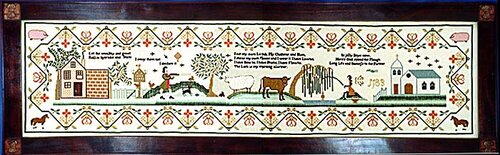
Note from the designer - "Mary Bailey stitched this sampler in England and finished it in 1818. It demonstrates an advanced level of skill given the symmetry of the design and its many diverse elements: a red brick mansion house with four chimneys- a sign of wealth in early 19th century England,... Read more
Note from the designer - "This sweet English sampler is the first I've ever seen with a border made up of flying cherubs. It also features a "geode" (mosaic) parrot- a distinctively stylized bird that appears on other samplers made in England, New England, and the Netherlands throughout... Read more
Note from the designer - This needlework was designed after an English sampler in the collection of the Museum of Fine Arts-Boston. The lush border flowers are similar to those on a sampler made by Sarah Brignell from around the same period, suggesting the existence of a school or teacher whose... Read more
Note from the designer - "This picture was originally designed to be used as a cushion or footstool cover, or perhaps as a decorative vignette inserted into the top of a wooden box for storing precious objects. Executed entirely in cross stitch, its most prominent characters are a large squirrel... Read more
Note from the designer - "This finely stitched German sampler begins with a single row of alphabets above an immensely intricate collection of symbolic cross stitched motifs, including battling angels, the figure of Justice with her scales, the spies of Canaan, the crucifixion, Adam and Eve... Read more
A RED BRICK MANSION HOUSE is at the center of this wildly engaging English sampler featuring a small
zoo/conservatory/aviary of flora and fauna as interpreted by an exceptionally talented young
woman of the early nineteenth century. The verse is common enough on nineteenth-century samplers, unlike... Read more
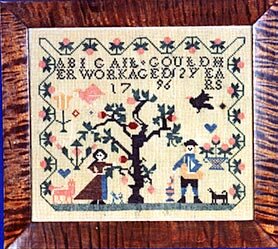
Note from the designer - "This sampler shows a man and a woman beneath an apple tree, reminiscent of Adam and Eve, but in contemporary dress. Possibly of New York origin (the format and background suggest this), this reproduction is stitched on linen with either cotton or silk, with the... Read more
Note from the designer - "A sophisticated painterly use of perspective distinguishes this pictorial English sampler. An idealized rural scene with a thatched cottage nestled in a fertile valley, with white misted hills rising in the distance, also features a windmill, a flock of sheep,... Read more
This is a pleasantly quirky, colorful sampler likely stitched in the north of England judging by some of the Scottish influences in the design. A four sided strawberry border surrounds an alphabet and a pious verse above a geometric pattern band. Below this is a scenic register with trees, birds,... Read more
This English sampler was made in Sheffield, South Yorkshire, featuring the Sheffield General Infirmary, a verse, a fashionably dressed man and woman, and a collection of animals in the lawn in front (sheep, fox, squirrels, rabbit, dog), all surrounded by a four sided berry border.
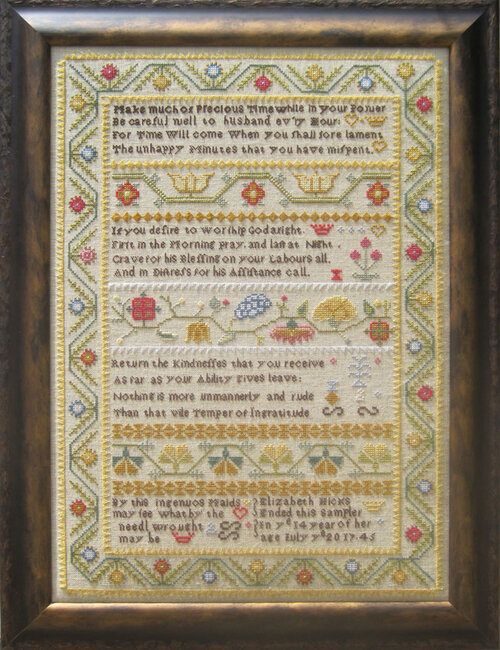
Note from the designer - "This beautiful. petite, energetic sampler expressed three fine verses and, at the end, one of the truest "signatures" I've ever read on a piece of needlework:
By this ingenous Maids
may see what by the
needl wrought
may be
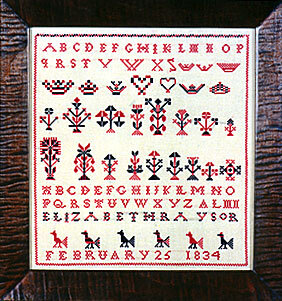
Note from the designer: "A Pennsylvania German sampler that may not be, strictly speaking, a miniature, but is nonetheless small for its type. Typical Pennsylvania German folk culture motifs - birds, trees, hearts, flowers, crowns and stars - adorn it."
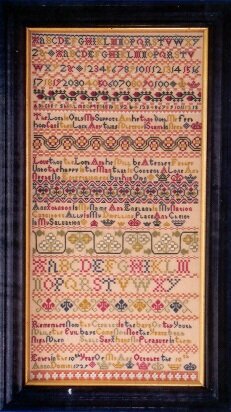
This sampler features two uncommon verses taken from the book Sentences and Maxims Divine, Moral and Historical, in Prose and Instruction of Human Life: and Particularly for the Improvement of Youth in Good Sence and correct English by George Shelley, published in London in 1712.
This sampler was made in Scotland and includes many of the traditional motifs associated with samplermaking in this region. Firstly, Janet has included many initials of family members. However the initials at the center- G R 3 -refer to the then-reigning monarch, King George III. The flowering... Read more
Note from the designer - "Acquired in England, one might assume that this classic Quaker motif sampler was made at the Ackworth School in Yorkshire. However the influence of the designs promulgated by the Quaker School needleworkers stretched far beyond the confines of the school's walls. This... Read more
A derivative 17th-century canvas work picture. The Adam and Eve legend was a more popular theme on samplers after the early eighteenth century so this example is quite unusual. The pair are not often seen on earlier needleworks, even though most illustrated bibles of the sixteenth and seventeenth... Read more
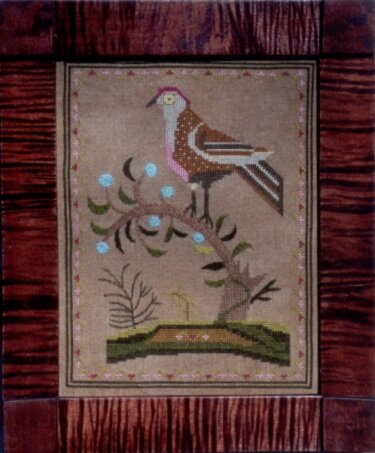
This 19th century American reproduction sampler features a brown bird on a tree branch. Rated for beginners. Model stitched on 35 count hand dyed linen using either cotton or silk thread. Two versions of the sampler graph have been furnished: one executed with a drawn partially freehand split and... Read more
Note from the designer - "In 1779, the Quaker Friends School at Ackworth, Yorkshire, was established for the purpose of educating young people of both sexes, and instilling the values of their Society; equality, simplicity, peace. Girls received nearly the same instruction as boys. Out of this... Read more
Note from the designer - "An intensely stitched and well-planned sampler, this unusual piece probably originated in Pennsylvania. The allegorical figure hovering over the house could represent Liberty. The unconnected border of floating honeysuckle is unique, as well as the little pastoral vignettes in the lower register." Rated for beginners.
Note from the designer - "This little needlework was likely made as a panel of a "huswif"/aka a "housewife", which was an embroidered, double-sided vertical series of pockets made to hold needleworking supplies. It could be folded up or hung from a peg for swift access to the... Read more
This American sampler was stitched on a loosely woven homespun linen with vegetable-dyed silk threads. Despite its size and simplicity, the design is striking, delicate, and well-balanced. Eunice Morton was born in 1783 in Gorham County, Maine. Sometime in 1809-1810, she married Jesse Harding, and... Read more
A unique four-sided geometric border is the highlight of this American sampler, consisting of nine rows of letters and numerals surrounded by a counted satin stitch sawtooth inner border. The design looks like something that might have inspired the Dutch artist Piet Mondrian. I have not been able... Read more
This is a beautiful sampler from Norwich (Norfolk, United Kingdom), possibly stitched at a school run by one Mrs. Wright or her descendent (hence the initials "MW" below Elizabeth's name in the attribution). A list of teachers in Norwich in 1783 includes Wright, Massey, and Cheetleburgh. The... Read more
Note from the designer - "ANN WHITTAKER created an almost comically theatrical sampler depicting Adam and Eve, angels, pious verses, and elaborate meandering vines beneath dramatic multi-colored draperies and tassels. Hovering over the verse which is framed by large columns, are two angels with... Read more
Note from the designer - "At the age of fourteen, Mary Lee stitched this beautiful band sampler with a good assortment of flowers, birds, swans, squirrels, and other traditional motifs. Worked into the center of a band in tight, precise stitches, is the cautionary aphorism "In thy youth... Read more
This sampler could possibly have been made in Connecticut but the surname is quite common throughout New England. Abigail was ten years old when she made her sampler. The original was stitched on unbleached homespun linen using silk threads, and the reproduction very closely approximates the size of... Read more
Note from the designer - "A characteristically northern German sampler, this example from Hamburg consists of random symbolic spot motifs, with a unifying central scene and borders. Religious symbols are commonly found on almost all continental samplers, and Adam and Eve in particular is often... Read more
Note from the designer - "This is a very graceful and finely stitched sampler, an unusual combination for the late date. Nine ethereal female figures, like penitents in an Edward Gorey cartoon, march solemnly about the sampler, paying homage to the house. The huge house appears to be welcoming... Read more
Note from the designer - "As the purpose for making samplers evolved over the decades and the centuries, so did its form. This beautiful early 18th century English band sampler retains the shape of her predecessors, but has clearly changed into a form distinctly recognizable as a product of her... Read more
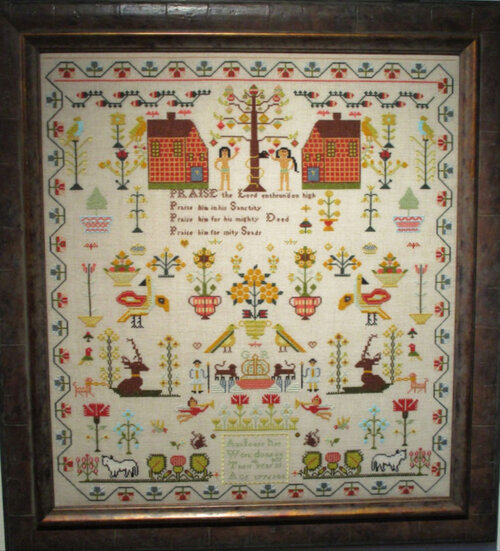
In the upper register of this finely stitched English sampler there is featured an unusual vignette of Adam and Eve beneath the tree of life (with a menacing black faced serpent) flanked by mirror image brick cottages, followed by a pious verse:
There is so much going on in this fascinating English sampler that it's hard to know where to begin looking. Apart from the somewhat conventional Adam and Eve at the top center, adorable flying cherubs flank them and the apple tree, bearing gold rings and sprays of flowers. The verse is as... Read more
Adapted from an English sampler dated 1783. The original sampler from which this piece was adapted measures 15 1/2" x 12 1/2", and was stitched over one thread of linen on approximately 50-thread-count glazed linen. The house on the left alone, which measures 71 by 62 squares on the graph,... Read more
This letterndoek (lettering) form of Dutch sampler appears from the late 17th through the early 19th century. It is easy to recognize by its horizontal shape, and beautifully illuminated lettering, interspersed with various symbolic shapes and Biblical motifs. The color scheme used on so many of... Read more
According to a note attached to the back of the original sampler, it was probably made near Newtown, Pennsylvania. The attribution at the center is surrounded by a typical Quaker leafy cartouche with opposing flowers and facing birds above. Other characteristic Quaker motifs include eight point... Read more
This English sampler combines embroidered pictorial, alphabetic, and upholstery techniques, becoming in every sense a sampler of Ms. Topham's best work. Bargello work (also known as canvaswork, Irish stitch, flamestitch, or Florentine stitch) appeared on the earliest seventeenth century samplers,... Read more
Note from the designer: "Adapted from a mid eighteenth century English sampler. The combination of several unusual stitch techniques with bold primary colors, makes this sampler outstandingly beautiful and a rewarding project to stitch.
While the majority is done in cross stitch, large... Read more
The Temperance Movement of the early nineteenth century began in the United States prior to 1808. Preachers, most notably John Bartholomew Gough, promulgated a pledge of abstinence from members of his congregation. While temperance efforts have existed as long as spirits have, the movement was not... Read more
Note from the designer: "This northern German sampler consists of random symbolic spot motifs, with a simple zigzag border. Religious symbols are commonly found on continental samplers. On this example, we find the wreath carried by angels (the wreath as a symbol for eternal life): the ship... Read more
Note from the designer: "The characteristic that readily identifies the origin of this sampler is the distinctive vine and rose border, configured such that a leaf on one side and a rosebud stem on the other give the illusion of a double vine. It is almost always found executed in cross stitch... Read more
Note from the designer: "Who would love this world or prize whats in it
that gives and takes and chops and changes every minute.
This brilliant English traditional band sampler comes from the collection of the Victoria & Albert Museum. Drawing on traditional sampler motifs of the 17th... Read more
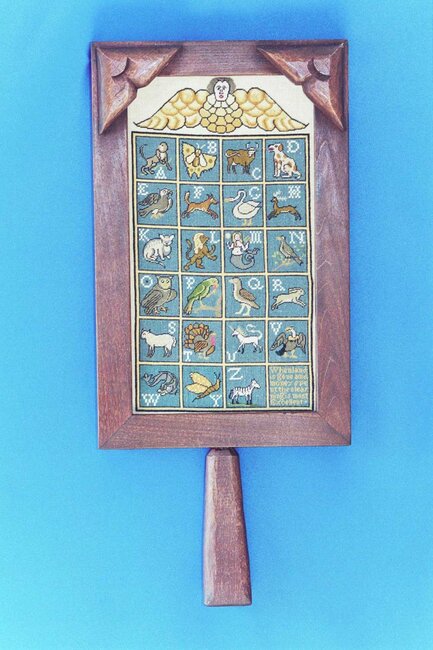
Note from the designer: "The figures depicted on this original design were derived from wood block engravings of the 17th, 18th and 19th centuries. The format of the hornbook follows actual examples from the late 18th century. Hornbooks functioned as primers, used to teach young children their... Read more
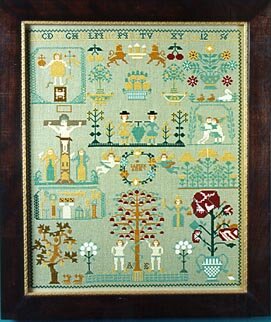
Note from the designer: "German and Dutch samplers are known for their iconography, especially the symbolic religious motifs. This piece, reproduced from the collection of the Allentown Art Museum in Allentown, Pennsylvania, portrays many of these motifs. Adam and Eve, in particular, are often... Read more
Note from the designer: "This Scottish sampler features many distinguishing characteristics of samplers made in that country, most notably the arcaded pansy band across the top third, the four-sided floral border with double running stitch flourishes, and the famous mansion house. Of this large... Read more
Note from the designer: "This Scottish sampler is a riot of brilliant color and intricate motifs, from the Scotsman in his kilt playing a traditional dulcimer (which looks like a butter churn) in the upper left, to an elaborate mansion house fronted by a three dimensional turkeywork lawn in the... Read more
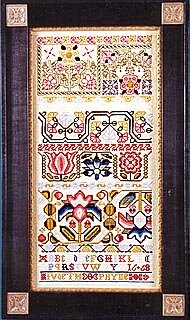
Note from the designer: "This small and brilliantly preserved band sampler demonstrates a wide variety of stitches found on many seventeenth century samplers. The beautifully shaded flower heads and leaves are filled in with connecting tiers of trellis stitch."
This is a reproduction of a Quaker sampler made in Chester County, Pennsylvania consisting of alphabets, numerals, ligatures* and lineal patterns executed in a variety of stitches. The uppermost border with the dangling central flower is often seen on American Quaker samplers of this period (see... Read more
This English sampler features a three-sided floral border surrounding thirteen lines of alphabets, neatly cross-stitched in several different lettering styles. Mary Wagstaff was likely born in Huyton, Lancashire in 1809, completing this sampler when she was ten years old. She passed away in... Read more

 ⇅
⇅
 801-495-0908
 Cart
Cart Wishlist