801-495-0908
 ⇅
⇅

 Cart
Cart Wishlist
 Large Spool - #2600 Dove Grey
 Large Spool - #2692 Black
 Large Spool - #2021 Natural White
 Large Spool - #2024 Bright White
 Small Spool - #2600 Dove Grey
 Small Spool - #2692 Black
 Small Spool - #2021 Natural White
 Small Spool - #2024 Bright White
 Large Spool - #2600 Dove Grey
 Large Spool - #2692 Black
 Large Spool - #2021 Natural White
 Large Spool - #2024 Bright White
 Small Spool - #2600 Dove Grey
 Small Spool - #2692 Black
 Small Spool - #2021 Natural White
 Small Spool - #2024 Bright White
 Large Spool - #2600 Dove Grey
 Large Spool - #2692 Black
 Large Spool - #2021 Natural White
 Large Spool - #2024 Bright White
 Small Spool - #2600 Dove Grey
 Small Spool - #2692 Black
 Small Spool - #2021 Natural White
 Small Spool - #2024 Bright White
Scarlet Letter Samplers Cross Stitch
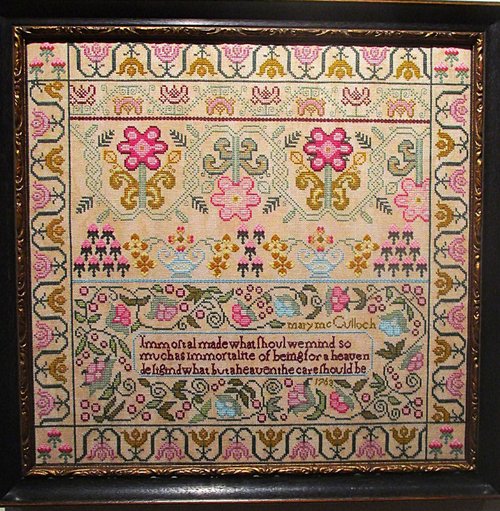
This Scottish sampler features a number of stylistic devices seen on other Scottish samplers of the eighteenth and nineteenth centuries including the intense color palette with an emphasis on reds and greens and the arcaded pansy band in the upper third.
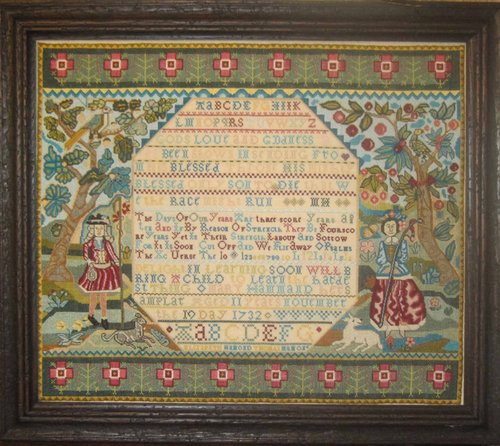
It has been densely stitched in a... Read more about Mary McCulloch 1763 - Cross Stitch Pattern In the early eighteenth century samplers began to evolve from long vertical bands into more rectangular shapes. They began to incorporate more pictorial and scenic images and scenes such as those found on seventeenth century canvas and stumpwork pictures. Alphabets, numerals and verses prevailed but... Read more about Mary Hammand 1732 - Cross Stitch Pattern A needlework picture designed after an early eighteenth century canvas work piece, featuring a tree, two unicorns, a peacock, a badger and more!
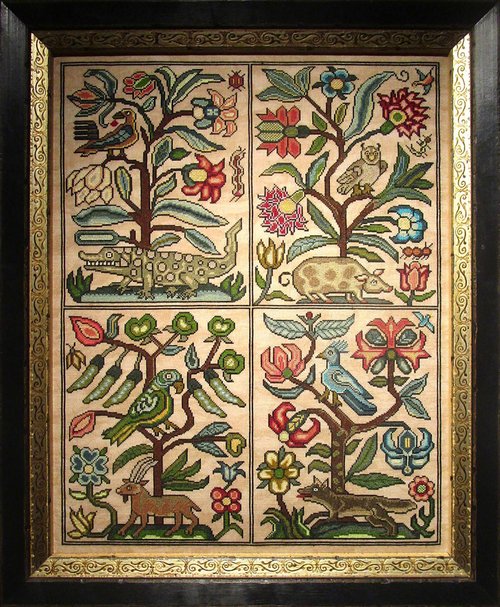
Stitched over two threads on 40 count linen of your choice, the finished size will measure approximately 16" x 17". Cross and counted... Read more about A Peacock, a Unicorn & a Badger - Cross Stitch Pattern A MISCELLANY: A Collection of Seventeenth Century Canvas work Elements from the Natural World
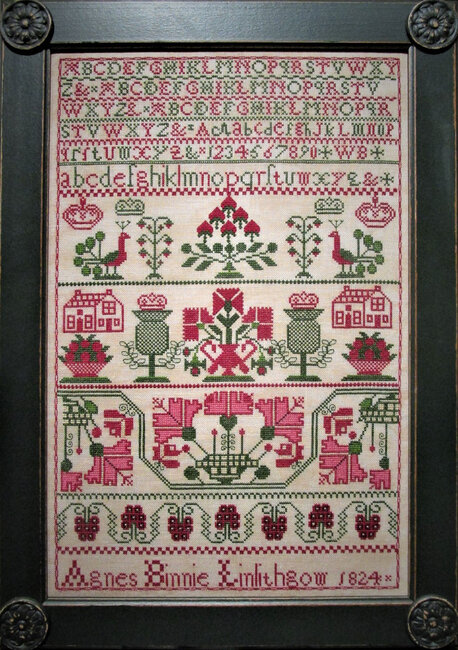
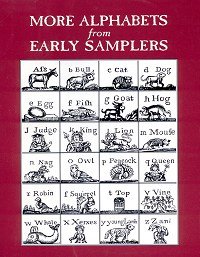
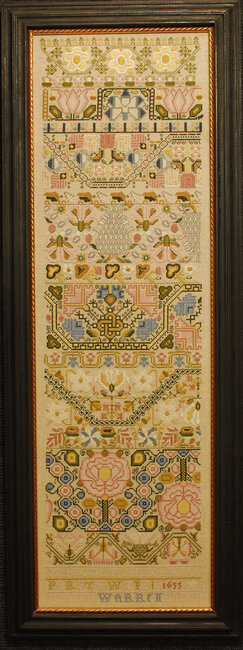
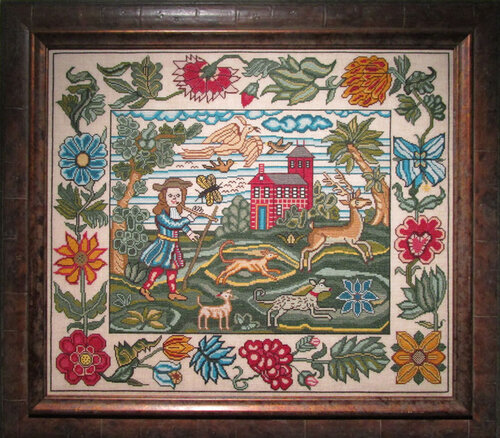
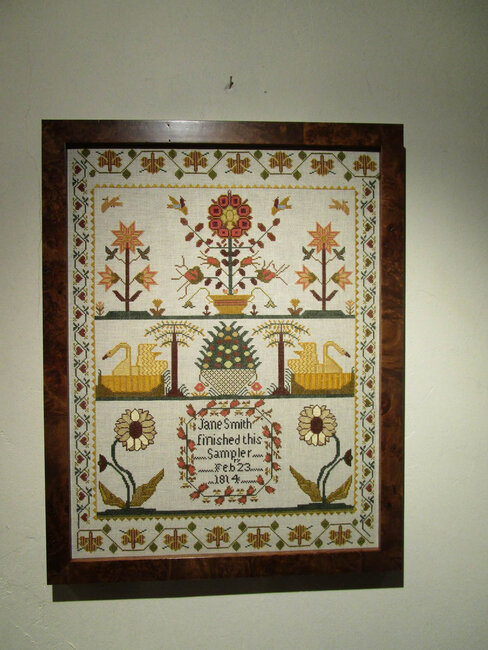
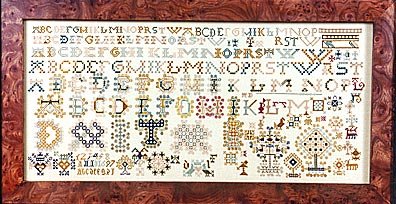
The subjects in this needlework design are taken from a seventeenth century canvas work, formerly in the collection of The Scarlet Letter, consisting of nine panels stitched primarily in shades... Read more about A Miscellany - Cross Stitch Pattern Agnes Binnie was born in Stirlingshire, Scotland, on March 22, 1808, to Robert Binnie and Mary Addie. She married James Barclay on March 16, 1832, in Falkirk, Stirlingshire. The couple had at least six sons and three daughters. Around 1870 they emigrated to Scotland Township in McDonough, Illinois.... Read more about Agnes Binnie 1824 - Cross Stitch Pattern Collected from German, Italian, Scottish, Dutch, English, and American samplers, this book of alphabets takes off from where the previous edition, Alphabets from Early Samplers, ends. The alphabets have been fastidiously reproduced from samplers dating from 1530, to 1868. Over 80 alphabets are charted, as well as two complete alphabet samplers, one of them dating from 1725. Note from the designer: "This densely worked sampler displays exquisite detail and contains many of the most popular needlework motifs of the seventeenth century. The flowers are realistically shaded to achieve a natural look." Finished size on 35 count linen is 7 1/4" x 25... Read more about Joanna Warren 1655 - Cross Stitch Pattern Note from the designer - "This picture was originally designed to be used as a cushion or footstool cover, or perhaps as a decorative vignette inserted into the top of a wooden box for storing precious objects. Executed entirely in cross stitch, its most prominent characters are a large squirrel... Read more about Elizabeth's Squirrel - Cross Stitch Pattern Note from the designer - "A sophisticated painterly use of perspective distinguishes this pictorial English sampler. An idealized rural scene with a thatched cottage nestled in a fertile valley, with white misted hills rising in the distance, also features a windmill, a flock of sheep,... Read more about Ann Brockbank 1812 - Cross Stitch Pattern Note from the designer - This is the most symmetrical, balanced, counted thread sampler that we have ever charted from. It is also one of the most satisfying, challenging, and beautiful samplers in the world. Originally worked on a fine wool ground, the colors of our reproduction have been matched... Read more about Dorcas Haynes 1720 - Cross Stitch Pattern Flora and fauna were highly celebrated in nearly all 17th and 18th century pictorial embroideries. Executed entirely in cross or tent (half cross) stitches, the embroidered pictures embellished cushions and furniture and reflected a changing attitude toward domestic comforts, by serving to brighten... Read more about Man Dogs and Deer - Cross Stitch Pattern This wonderfully symmetrical English sampler features a pair of silky floating swans and large twin sunflowers, executed in a rich natural palette of color. Birds fly over the tops of three flower-trees in the top third. A sumptuous basket of fruit is stitched between the golden swans, and towering... Read more about Jane Smith 1814 - Cross Stitch Pattern Note from the designer: "This intricate and involved sampler features many traditional German sampler motifs dating from the sixteenth century including a large parrot, a peacock with silver tips on its wings, the Lamb of God, as well as a depiction of the Crucifixion flanked by Mother Mary and... Read more about A German Sampler Dated 1704 "IES" - Pattern Note from the designer - "This sweet English sampler is the first I've ever seen with a border made up of flying cherubs. It also features a "geode" (mosaic) parrot- a distinctively stylized bird that appears on other samplers made in England, New England, and the Netherlands throughout... Read more about Elizabeth Eyles 1799 - Cross Stitch Pattern Note from the designer - "Eleanor Parr created this amazing and unique sampler some time before 1835. The border of birds encircled by vines and leaves is unprecedented. Fleurs de lys embellish each of the four corners surrounding a central reserve containing a traditional verse, floral sprays... Read more about Eleanor Parr 1816 - Cross Stitch Pattern Note from the designer - "An intensely stitched and well-planned sampler, this unusual piece probably originated in Pennsylvania. The allegorical figure hovering over the house could represent Liberty. The unconnected border of floating honeysuckle is unique, as well as the little pastoral... Read more about Rebecca Robinson 1821 - Cross Stitch Pattern This is a very fine example of an early northern Dutch sampler called a letterndoek, or alphabet sampler. The illuminated letters are typical of northern Holland needleworks. Symbolic spot motifs include dogs, a stag, trees of life, and paired birds.
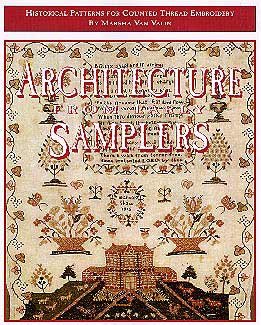
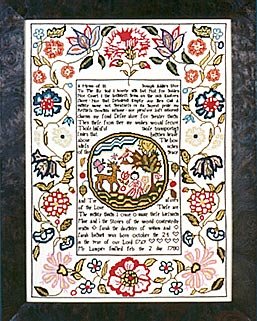
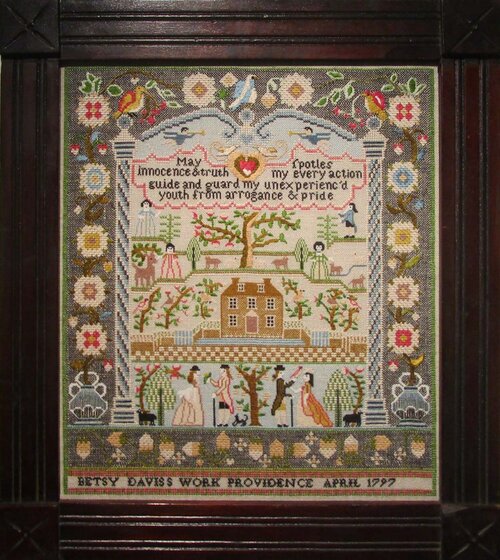
Pattern is stitched on the fabric of... Read more about The Letterndoek Sampler by IT 1697 - Cross Stitch Pattern The first book of its kind to be published, this collection of over one hundred charted reproductions of buildings from samplers and needlework of the seventeenth through the mid-nineteenth centuries fills a huge void in the body of sampler publications. It includes many photos of the finished... Read more about Architecture From Early Samplers - Cross Stitch Book Try as we might, we cannot find another sampler to compare with this one by Sarah Brignell. It is a sampler unto itself: truly an original piece of folk art. The tiny central cartouche with the densely stitched scene floats like a little world unto itself in the midst of the exuberant garden of... Read more about Sarah Brignell 1769 - Christian Cross Stitch Pattern This extraordinary piece of seventeenth century needlework was originally executed with fine silks on a linen ground, in tent stitch, and is composed of many different slips" or spot motifs, cleverly fitted together. Many of these motifs have symbolic and/or heraldic significance, and they can... Read more about Spot Motif Embroidered Picture 1640 Cross Stitch Pattern Made in Providence, Rhode Island, this sampler is a superb example of the work done at Miss Mary (Polly) Balch's school, one of the most important female learning institutions in America at that time. Combining sophisticated architectural, landscape and figural motifs with elaborate and unusual... Read more about Betsy Davis 1797 - Cross Stitch Pattern This mid-eighteenth-century Scottish band sampler features many classic seventeenth-century patterns, executed in cross, eyelet, double running, counted satin, back, and queen stitches.
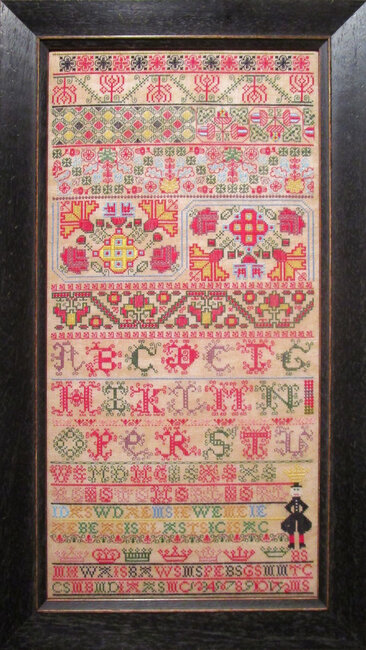
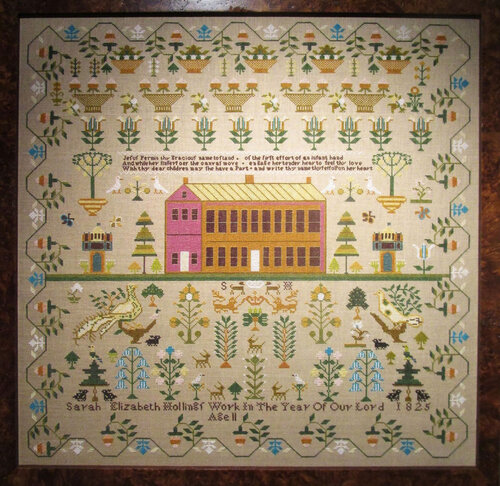
The virtually unfaded color was reproduced from the front of the sampler. Six pattern bands precede... Read more about MS Dated 1752 - Cross Stitch Pattern This is an expansive English sampler with an unusual four-sided leafy branch and floral border, centering a very busy reserve filled with baskets of fruits and flowers, stylized trees and plants, birds, lions rampant, butterflies, rabbits, and stags. A large building/mansion/institution is at the... Read more about Sarah Elizabeth Hollings 1825 - Cross Stitch Pattern Note from the designer - "Rhode Island samplers were among the first American schoolgirl embroideries to be recognized by serious collectors and textile scholars as a distinctive group with extraordinary visual appeal. The Sheffield sampler is delicately worked with an unusually pleasing... Read more about Elizabeth Sheffield 1784 - Cross Stitch Pattern This reproduction sampler is from the Ackworth Quaker School and is dated 1818. It is rated for beginners.
Linen count and finished size: 35 or 40 count; 18-3/4" x 24-1/2" or 16-1/2" x 21-1/2". Stitch count is 330 X 430. Chart only. Note from the designer - "This finely stitched German sampler begins with a single row of alphabets above an immensely intricate collection of symbolic cross stitched motifs, including battling angels, the figure of Justice with her scales, the spies of Canaan, the crucifixion, Adam and Eve... Read more about Hanna Katerina 1734 German Sampler - Cross Stitch Pattern A RED BRICK MANSION HOUSE is at the center of this wildly engaging English sampler featuring a small
zoo/conservatory/aviary of flora and fauna as interpreted by an exceptionally talented young
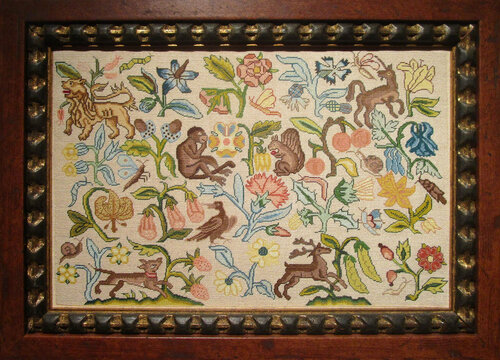
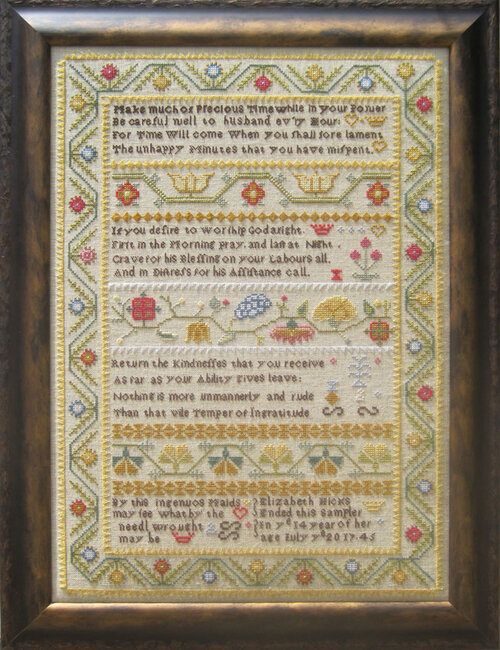
woman of the early nineteenth century. The verse is common enough on nineteenth-century samplers, unlike... Read more about Jane Moore 1820 - Cross Stitch Pattern Note from the designer - "This Dover, Massachusetts, sampler features an unusual border surrounding alphabetical and numerical tests, and a four-line verse often found on early 19th century American samplers. The colors are remarkably well preserved. The maker, Ann Harding (who was actually... Read more about Ann Harding 1821 - Cross Stitch Pattern This is a pleasantly quirky, colorful sampler likely stitched in the north of England judging by some of the Scottish influences in the design. A four sided strawberry border surrounds an alphabet and a pious verse above a geometric pattern band. Below this is a scenic register with trees, birds,... Read more about Elizabeth Cheetham 1824 - Cross Stitch Pattern Note from the designer - "This beautiful. petite, energetic sampler expressed three fine verses and, at the end, one of the truest "signatures" I've ever read on a piece of needlework: By this ingenous Maids may see what by the needl wrought may be ... Read more about Elizabeth Hicks 1745 - Cross Stitch Pattern This is a reproduction of an English sampler that features a four-sided carnation border, centering many intricate organic petit point motifs. The large mansion house dominates the central reserve, standing above an extensive pasture occupied by two very large and cockeyed sheep. These imaginative... Read more about Elizabeth Lilly 1801 - Cross Stitch Pattern Note from the designer: "Our own original design created in collaboration with Terry Meinke, draws upon the needlework traditions of two centuries, in both England and America. The idyllic landscape and more naturalistic figures (as opposed to the blocky shapes of later figures on American... Read more about Fishing Lady - Cross Stitch Pattern Note from the designer: "Mourning pictures were not an uncommon art form in England and America during the late eighteenth and early nineteenth centuries. Evolving from European commemorative art honoring deceased heroes, mourning pictures were a cherished way to remember loved ones, designed to... Read more about Four Angels Mourning Sampler - Cross Stitch Pattern Note from the designer: "Who would love this world or prize whats in it
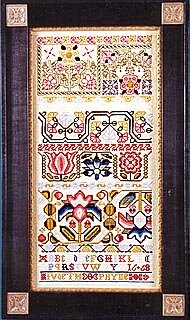
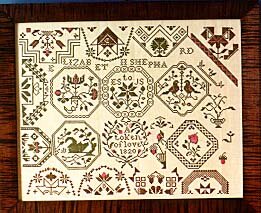
that gives and takes and chops and changes every minute. This brilliant English traditional band sampler comes from the collection of the Victoria & Albert Museum. Drawing on traditional sampler motifs of the 17th... Read more about Grace Catlin 1719 - Cross Stitch Pattern Note from the designer: "This finely worked sampler features pastoral scenes above and below a lovely verse about friendship. A four-sided honeysuckle border surrounds large baskets of fruits and flowers, a fenced pasture with seven large lazy sheep and an architectural folly in the background.... Read more about Grazing Sheep circa 1810 - Cross Stitch Pattern Note from the designer: "This small and brilliantly preserved band sampler demonstrates a wide variety of stitches found on many seventeenth century samplers. The beautifully shaded flower heads and leaves are filled in with connecting tiers of trellis stitch." Finished size on 35... Read more about Judeth Payne 1668 - Cross Stitch Pattern Note from the designer - "Acquired in England, one might assume that this classic Quaker motif sampler was made at the Ackworth School in Yorkshire. However the influence of the designs promulgated by the Quaker School needleworkers stretched far beyond the confines of the school's walls. This... Read more about Elizabeth Shephard 1820 - Cross Stitch Pattern This reproduction sampler is from the Ackworth Quaker School and is dated 1800. It is rated for beginners.
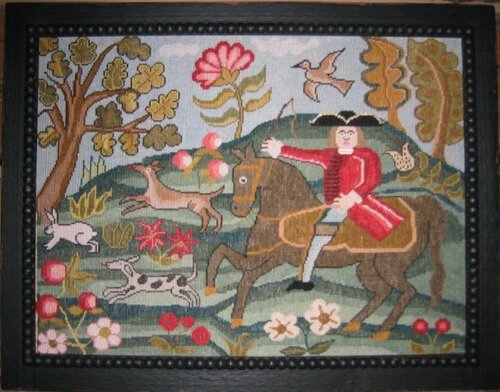
Linen count and finished size: 35 or 40 count using either cotton or silk floss, 19" x 21" or 17" x 18-1/2" Chart only. Note from the designer - "The design of this piece was inspired by fine examples of early eighteenth century American and English needlework pictures. A picture like this would have been stitched as a painting, with great attention to detail, shading, color, and composition." The design... Read more about The Huntsman - Cross Stitch Pattern A derivative 17th-century canvas work picture. The Adam and Eve legend was a more popular theme on samplers after the early eighteenth century so this example is quite unusual. The pair are not often seen on earlier needleworks, even though most illustrated bibles of the sixteenth and seventeenth... Read more about And All Was For An Appil - Cross Stitch Pattern Note from the designer - This needlework was designed after an English sampler in the collection of the Museum of Fine Arts-Boston. The lush border flowers are similar to those on a sampler made by Sarah Brignell from around the same period, suggesting the existence of a school or teacher whose... Read more about Jane Atkinson circa 1780 - Cross Stitch Pattern Note from the designer - "This design was inspired by an early eighteenth century English picture executed in tent stitch." The designs features a lion, a leopard and a parrot surrounded by bright flowers.
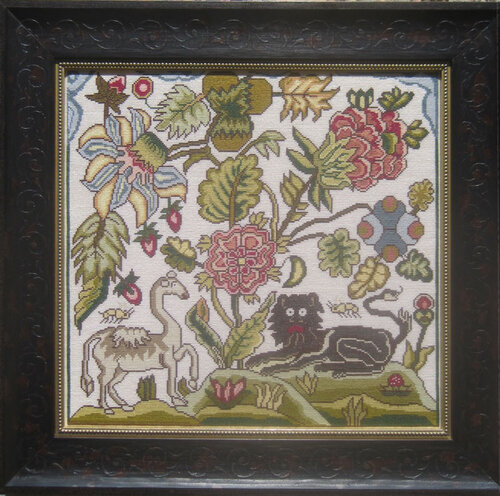
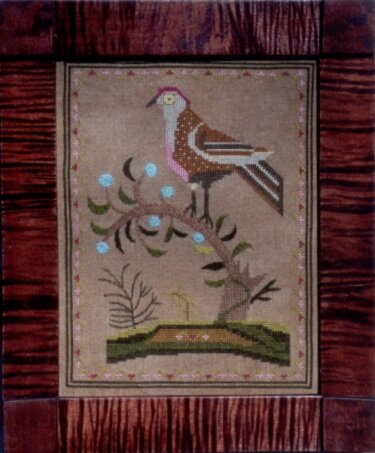
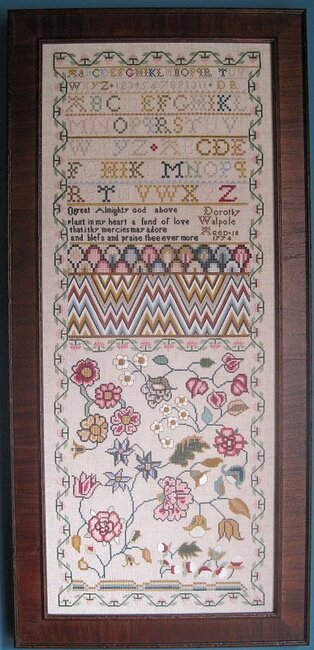
The design is stitched over one thread on 35 Ct. linen. It uses cross... Read more about A Parrot, A Leopard, A Lion - Cross Stitch Pattern This sampler features a lion, a camel, and large colorful flowers. The design was stitched over 2 threads on 40 Ct. linen and is suitable for all skill levels. The stitch count for each design is 244 W x 230 H. The finished piece will measure approximately 12-1/2″ x 11-1/2″. This 19th century American reproduction sampler features a brown bird on a tree branch. Rated for beginners. Model stitched on 35 count hand dyed linen using either cotton or silk thread. Two versions of the sampler graph have been furnished: one executed with a drawn partially freehand split and... Read more about Bird in Bough - Cross Stitch Pattern This Irish Quaker sampler features an alphabet at the tope, verse, bands, and flowers. The verse reads "Great Almighty God above plant in my heart a fund of love, that I my mercies may adore and bless and praise thee evermore."
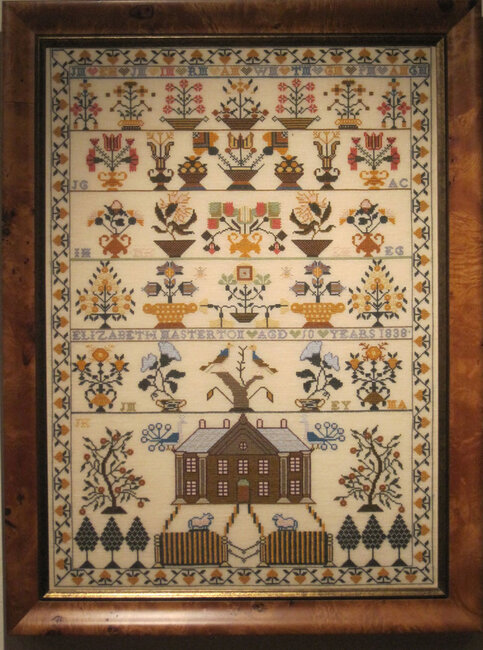
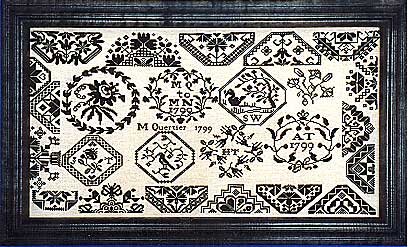
Model is stitched on 40 ct linen using either cotton... Read more about Dorothy Walpole 1774 - Cross Stitch Pattern Note from the designer - "Typical of so many Scottish samplers, Elizabeth Masterton's features an abundance of initials (likely familial), rows of evergreen trees, peacocks with seven tail feathers, and the now famous mansion house fronted by a pillared fence and gates enclosing sheep. Apart... Read more about Elizabeth Masterton 1838 - Cross Stitch Pattern Note from the designer - "In 1779, the Quaker Friends School at Ackworth, Yorkshire, was established for the purpose of educating young people of both sexes, and instilling the values of their Society; equality, simplicity, peace. Girls received nearly the same instruction as boys. Out of this... Read more about M Quertier 1799 - Cross Stitch Pattern Note from the designer - "At age nine in 1818, Sarah Dutnel created this unusual "tree of life" sampler. A traditional carnation and tulip border in subtle, earthy shades of gold, brown, and cream surrounds the tree. Dogs, deer, birds, stars, potted plants, trees and flowers flank the... Read more about Sarah Dutnel 1818 - Cross Stitch Pattern Currently on page 1 Go to page 2 Go to page 3 |