Band samplers of the 17th century exhibit the widest range of stitches and techniques. Counted thread stitches on linen were artfully combined with panels of floral, geometric, or figural cut and drawn work- a technique where the background threads of linen are carefully bound, then cut and pulled... Read more
This sweet little American sampler features two little houses above alphabets and a short verse:
Would you be wise
Each moment prize
It is surrounded on four sides by a double sided satin stitched sawtooth border. Stitches used include cross, outline, stem filling, counted... Read more
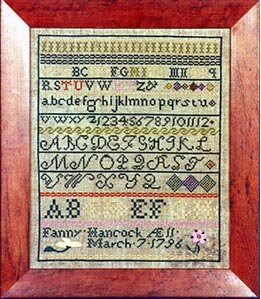
Fanny Hancock's father, Ebenezer Hancock, was cousin to the famous John Hancock. Born in 1785, Fanny sewed her sampler at age 11. She married Nathaniel Parker of Boston in 1803, and died in 1834. The colors on the back side of her sampler retained much of their original brilliance, and are... Read more
Note from the designer: "This naive Adam and Eve sampler might have been made in Maryland around 1810. At first I believed that the sampler was either English or Irish, judging by the unusual surname, until, in my research, I came upon the gravestone of a Fanny H. Peachey, born 24 November 1799,... Read more
Note from the designer: "This sampler was probably made in Rhode Island, a poor sister, perhaps, to the magnificent creations coming out of the girls' schools in Newport, Providence and Bristol at this same period, but bearing some similar "signatures". The squat, long-tailed bird at the... Read more
This sampler features two uncommon verses taken from the book Sentences and Maxims Divine, Moral and Historical, in Prose and Instruction of Human Life: and Particularly for the Improvement of Youth in Good Sence and correct English by George Shelley, published in London in 1712.
"Jesus permit thy Gracious name to stand as the first effort of an infant hand. And while her fingers on the canvas move, engage her tender thoughts to seek thy love. With thy dear children, let her have a part and write thy name thyself upon her heart."
Note from the designer: "From Dover, Massachusetts, comes Harriot Boardman's sampler, originally worked on a distinctive green linsey-woolsey found only on some North Shore samplers. A three-sided sawtooth border surrounds alphabet and numeral tests with geometric cross bands, two deer with... Read more
Displaying the traditional color scheme of Scottish samplers, this beautiful and delicately stitched piece also employs a variety of interesting counted thread stitches including queen, doublerunning, four-sided, back, counted satin filling, cross, Algerian eyelet, and cross over one (petit... Read more
This sampler was made in Scotland and includes many of the traditional motifs associated with samplermaking in this region. Firstly, Janet has included many initials of family members. However the initials at the center- G R 3 -refer to the then-reigning monarch, King George III. The flowering... Read more
Note from the designer - "An intensely stitched and well-planned sampler, this unusual piece probably originated in Pennsylvania. The allegorical figure hovering over the house could represent Liberty. The unconnected border of floating honeysuckle is unique, as well as the little pastoral vignettes in the lower register." Rated for beginners.
Note from the designer - "This little needlework was likely made as a panel of a "huswif"/aka a "housewife", which was an embroidered, double-sided vertical series of pockets made to hold needleworking supplies. It could be folded up or hung from a peg for swift access to the... Read more
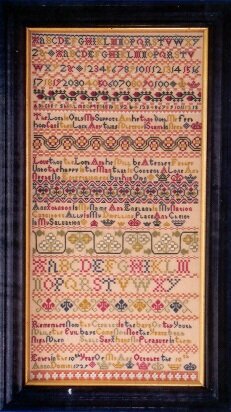
This American sampler was stitched on a loosely woven homespun linen with vegetable-dyed silk threads. Despite its size and simplicity, the design is striking, delicate, and well-balanced. Eunice Morton was born in 1783 in Gorham County, Maine. Sometime in 1809-1810, she married Jesse Harding, and... Read more
A unique four-sided geometric border is the highlight of this American sampler, consisting of nine rows of letters and numerals surrounded by a counted satin stitch sawtooth inner border. The design looks like something that might have inspired the Dutch artist Piet Mondrian. I have not been able... Read more
This is a beautiful sampler from Norwich (Norfolk, United Kingdom), possibly stitched at a school run by one Mrs. Wright or her descendent (hence the initials "MW" below Elizabeth's name in the attribution). A list of teachers in Norwich in 1783 includes Wright, Massey, and Cheetleburgh. The... Read more
Note from the designer - "At the age of fourteen, Mary Lee stitched this beautiful band sampler with a good assortment of flowers, birds, swans, squirrels, and other traditional motifs. Worked into the center of a band in tight, precise stitches, is the cautionary aphorism "In thy youth... Read more
Note from the designer - "Although there has not been the extensive research and study of English Quaker samplers as there has been of their American counterparts, we believe that this sampler was created under the tutelage of a Quaker sewing instructress in England. The fine bleached linen and... Read more
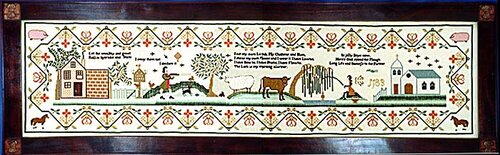
Note from the designer - "Samplers depicting children - particularly such large children - are uncommon. Not only the children make this an outstanding sampler, but also the multi-floral border, the charming verse, the scene at the top with its menagerie of creatures, and the beautiful... Read more
Note from the designer - "As the purpose for making samplers evolved over the decades and the centuries, so did its form. This beautiful early 18th century English band sampler retains the shape of her predecessors, but has clearly changed into a form distinctly recognizable as a product of her... Read more
Adapted from an English sampler dated 1783. The original sampler from which this piece was adapted measures 15 1/2" x 12 1/2", and was stitched over one thread of linen on approximately 50-thread-count glazed linen. The house on the left alone, which measures 71 by 62 squares on the graph,... Read more
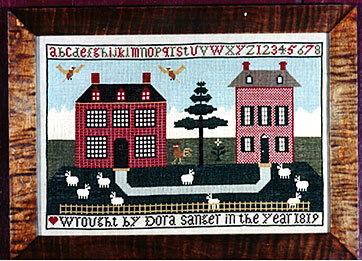
This sampler is a fanciful adaptation of 19th century American and English sampler motifs. Fluffy white sheep are outstanding on a large green lawn that stretches between two elegant red brick houses that are flanked by flying eagles. Needlework pictures of this type can be considered as traditional... Read more
This letterndoek (lettering) form of Dutch sampler appears from the late 17th through the early 19th century. It is easy to recognize by its horizontal shape, and beautifully illuminated lettering, interspersed with various symbolic shapes and Biblical motifs. The color scheme used on so many of... Read more
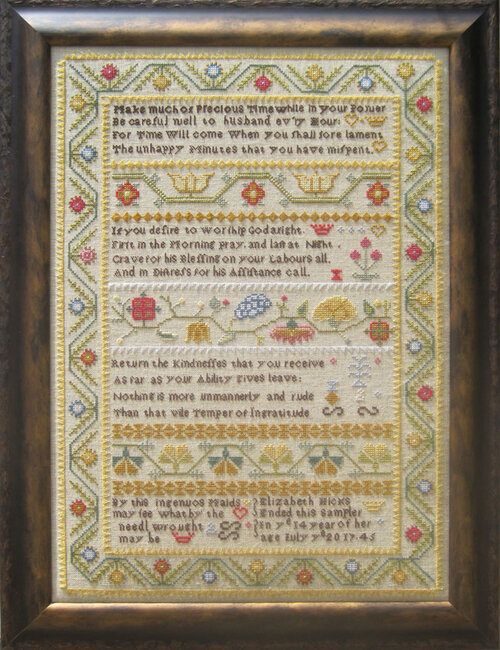
Note from the designer - "This beautiful. petite, energetic sampler expressed three fine verses and, at the end, one of the truest "signatures" I've ever read on a piece of needlework:
By this ingenous Maids
may see what by the
needl wrought
may be
According to a note attached to the back of the original sampler, it was probably made near Newtown, Pennsylvania. The attribution at the center is surrounded by a typical Quaker leafy cartouche with opposing flowers and facing birds above. Other characteristic Quaker motifs include eight point... Read more
This English sampler combines embroidered pictorial, alphabetic, and upholstery techniques, becoming in every sense a sampler of Ms. Topham's best work. Bargello work (also known as canvaswork, Irish stitch, flamestitch, or Florentine stitch) appeared on the earliest seventeenth century samplers,... Read more
Note from the designer: "Adapted from a mid eighteenth century English sampler. The combination of several unusual stitch techniques with bold primary colors, makes this sampler outstandingly beautiful and a rewarding project to stitch.
While the majority is done in cross stitch, large... Read more
The Temperance Movement of the early nineteenth century began in the United States prior to 1808. Preachers, most notably John Bartholomew Gough, promulgated a pledge of abstinence from members of his congregation. While temperance efforts have existed as long as spirits have, the movement was not... Read more
Note from the designer: "This northern German sampler consists of random symbolic spot motifs, with a simple zigzag border. Religious symbols are commonly found on continental samplers. On this example, we find the wreath carried by angels (the wreath as a symbol for eternal life): the ship... Read more
Note from the designer: "The characteristic that readily identifies the origin of this sampler is the distinctive vine and rose border, configured such that a leaf on one side and a rosebud stem on the other give the illusion of a double vine. It is almost always found executed in cross stitch... Read more
Note from the designer: "Who would love this world or prize whats in it
that gives and takes and chops and changes every minute.
This brilliant English traditional band sampler comes from the collection of the Victoria & Albert Museum. Drawing on traditional sampler motifs of the 17th... Read more
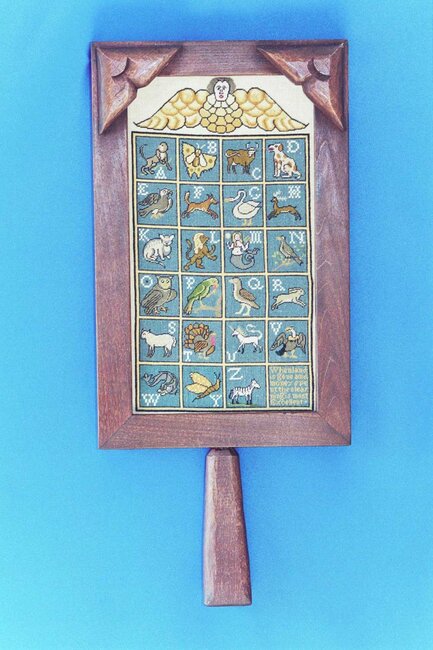
Note from the designer: "The figures depicted on this original design were derived from wood block engravings of the 17th, 18th and 19th centuries. The format of the hornbook follows actual examples from the late 18th century. Hornbooks functioned as primers, used to teach young children their... Read more
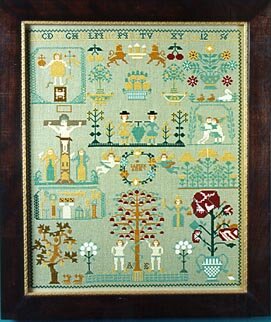
Note from the designer: "German and Dutch samplers are known for their iconography, especially the symbolic religious motifs. This piece, reproduced from the collection of the Allentown Art Museum in Allentown, Pennsylvania, portrays many of these motifs. Adam and Eve, in particular, are often... Read more
Note from the designer: "This Scottish sampler features many distinguishing characteristics of samplers made in that country, most notably the arcaded pansy band across the top third, the four-sided floral border with double running stitch flourishes, and the famous mansion house. Of this large... Read more
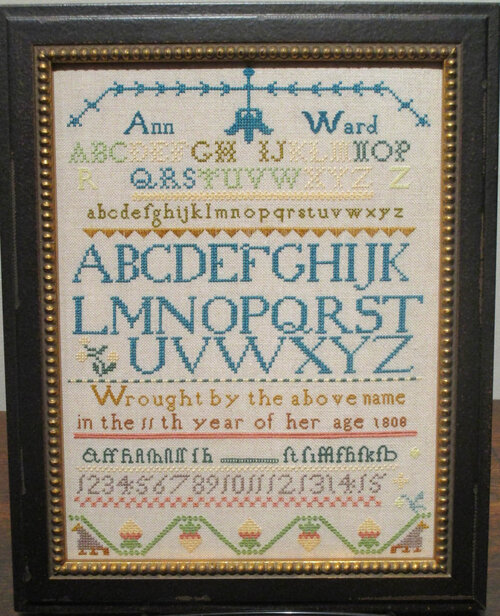
This is a reproduction of a Quaker sampler made in Chester County, Pennsylvania consisting of alphabets, numerals, ligatures* and lineal patterns executed in a variety of stitches. The uppermost border with the dangling central flower is often seen on American Quaker samplers of this period (see... Read more
This English sampler features a three-sided floral border surrounding thirteen lines of alphabets, neatly cross-stitched in several different lettering styles. Mary Wagstaff was likely born in Huyton, Lancashire in 1809, completing this sampler when she was ten years old. She passed away in... Read more
Here is a dainty and colorful mid-eighteenth-century English sampler executed entirely in cross and petit point stitches making it a suitable project for any skill level.
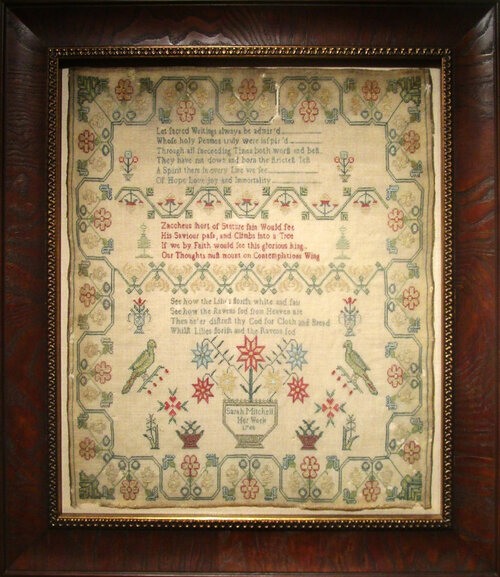
A four-sided arcaded border of daisies and dianthus surrounds three pious verses with delicate horizontal floral bands... Read more

 ⇅
⇅
 801-495-0908
 Cart
Cart Wishlist