801-495-0908
 ⇅
⇅

 Cart
Cart Wishlist
 Large Spool - #2600 Dove Grey
 Large Spool - #2692 Black
 Large Spool - #2021 Natural White
 Large Spool - #2024 Bright White
 Small Spool - #2600 Dove Grey
 Small Spool - #2692 Black
 Small Spool - #2021 Natural White
 Small Spool - #2024 Bright White
 Large Spool - #2600 Dove Grey
 Large Spool - #2692 Black
 Large Spool - #2021 Natural White
 Large Spool - #2024 Bright White
 Small Spool - #2600 Dove Grey
 Small Spool - #2692 Black
 Small Spool - #2021 Natural White
 Small Spool - #2024 Bright White
 Large Spool - #2600 Dove Grey
 Large Spool - #2692 Black
 Large Spool - #2021 Natural White
 Large Spool - #2024 Bright White
 Small Spool - #2600 Dove Grey
 Small Spool - #2692 Black
 Small Spool - #2021 Natural White
 Small Spool - #2024 Bright White
Samplers Cross Stitch Page 53
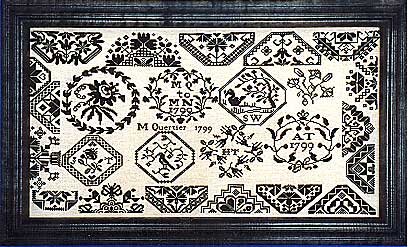
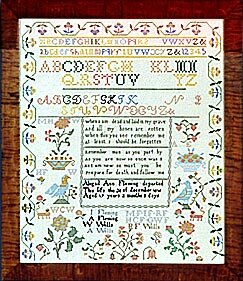
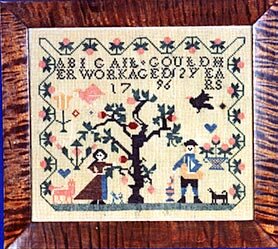
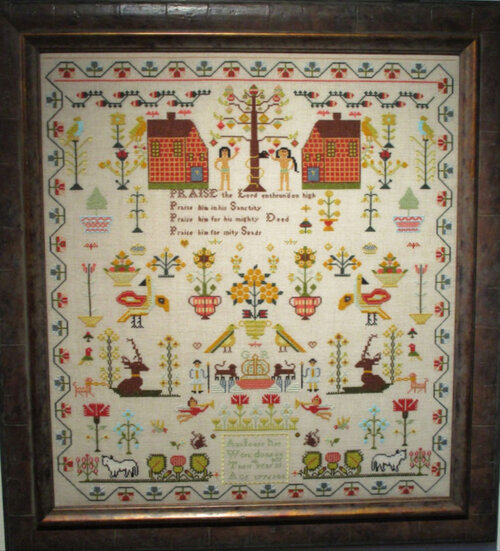
Note from the designer - "In 1779, the Quaker Friends School at Ackworth, Yorkshire, was established for the purpose of educating young people of both sexes, and instilling the values of their Society; equality, simplicity, peace. Girls received nearly the same instruction as boys. Out of this... Read more about M Quertier 1799 - Cross Stitch Pattern Note from the designer - "At age nine in 1818, Sarah Dutnel created this unusual "tree of life" sampler. A traditional carnation and tulip border in subtle, earthy shades of gold, brown, and cream surrounds the tree. Dogs, deer, birds, stars, potted plants, trees and flowers flank the... Read more about Sarah Dutnel 1818 - Cross Stitch Pattern Note from the designer - "Mary Bailey stitched this sampler in England and finished it in 1818. It demonstrates an advanced level of skill given the symmetry of the design and its many diverse elements: a red brick mansion house with four chimneys- a sign of wealth in early 19th century England,... Read more about Mary Bailey 1818 - Cross Stitch Pattern Note from the designer - "Designed after a mid-eighteenth century New Hampshire sampler, this piece is delightfully naive with its oversized animals, insects, and birds. Around 1760, the New-Hampshire Gazette began publishing advertisements for girls' schools, placed by female instructresses,... Read more about Susan Singleton - Cross Stitch Pattern Note from the designer - "Designed after an early eighteenth century tent stitched picture, this expansive needlework scene depicts many episodes in the life of an affluent English family including its elaborate parterre and gardens, a stately brick and stone house, domestic, exotic and wild... Read more about The Manifesto - Cross Stitch Pattern Note from the designer - "This little needlework was likely made as a panel of a "huswif"/aka a "housewife", which was an embroidered, double-sided vertical series of pockets made to hold needleworking supplies. It could be folded up or hung from a peg for swift access to the... Read more about Huswife Circa 1780 - Cross Stitch Pattern This American sampler was stitched on a loosely woven homespun linen with vegetable-dyed silk threads. Despite its size and simplicity, the design is striking, delicate, and well-balanced. Eunice Morton was born in 1783 in Gorham County, Maine. Sometime in 1809-1810, she married Jesse Harding, and... Read more about Eunice Morton 1794 - Cross Stitch Pattern A unique four-sided geometric border is the highlight of this American sampler, consisting of nine rows of letters and numerals surrounded by a counted satin stitch sawtooth inner border. The design looks like something that might have inspired the Dutch artist Piet Mondrian. I have not been able... Read more about Emely C Newman 1831 - Cross Stitch Pattern This is a beautiful sampler from Norwich (Norfolk, United Kingdom), possibly stitched at a school run by one Mrs. Wright or her descendent (hence the initials "MW" below Elizabeth's name in the attribution). A list of teachers in Norwich in 1783 includes Wright, Massey, and Cheetleburgh. The... Read more about Elizabeth Gooding 1790 - Cross Stitch Pattern Note from the designer - "ANN WHITTAKER created an almost comically theatrical sampler depicting Adam and Eve, angels, pious verses, and elaborate meandering vines beneath dramatic multi-colored draperies and tassels. Hovering over the verse which is framed by large columns, are two angels with... Read more about Ann Whittaker 1790 - Cross Stitch Pattern Note from the designer - "Abigail Ann was born October 27, 1799, in East Caln, Chester County Pennsylvania. Her parents were Joseph and Ann (Wells) Fleming, the fourth generation of Flemings living in the East Caln area. Abigail Ann attended one of the Quaker schools in Chester County but we are... Read more about Abigail Ann Fleming 1816 - Cross Stitch Pattern Note from the designer - "This sampler shows a man and a woman beneath an apple tree, reminiscent of Adam and Eve, but in contemporary dress. Possibly of New York origin (the format and background suggest this), this reproduction is stitched on linen with either cotton or silk, with the... Read more about Abigail Gould's Sampler 1796 - Cross Stitch Pattern Note from the designer - "A characteristically northern German sampler, this example from Hamburg consists of random symbolic spot motifs, with a unifying central scene and borders. Religious symbols are commonly found on almost all continental samplers, and Adam and Eve in particular is often... Read more about German Sampler by AEDEGNES 1746 - Cross Stitch Pattern Note from the designer - "This sampler was made in St. Albans, Vermont. A naturalistic four-sided floral border surrounds a central reserve with alphabets and a pictorial scene. The house is so distinctive that it is probably a depiction of Amanda's own home. Made under the tutelage of B.... Read more about Amanda Jewel 1816 - Cross Stitch Pattern Note from the designer - "This unusual sampler is probably of Scottish origin. The distinctive French-inspired mansion house and the peacocks are commonly found on Scottish samplers. Adam and Eve are realistically stitched in the Garden, by effectively working two quite simple stitches together:... Read more about Ann Bowden 1811 - Cross Stitch Pattern Note from the designer - "This is a very graceful and finely stitched sampler, an unusual combination for the late date. Nine ethereal female figures, like penitents in an Edward Gorey cartoon, march solemnly about the sampler, paying homage to the house. The huge house appears to be welcoming... Read more about Ann Cottee 1848 - Cross Stitch Pattern Note from the designer - "A classic Quaker sampler from the Delaware Valley, this sampler demonstrates the style and many of the motifs that make them so easy to identify. The inner oval vine-and-leaf cartouche surrounding the alphabets probably originated at the Westtown School in Chester... Read more about Ann Fleming - Cross Stitch Pattern Note from the designer - "This very delicate Scottish sampler with its bold color scheme was designed with a four sided stylized honeysuckle border surrounding horizontal rows of illuminated alphabets and double running stitch motifs. The extensive use of double running stitch lends the sampler... Read more about Ann Forrest 1757 - Cross Stitch Pattern Note from the designer - "This is a beautifully balanced, intensely stitched transitional sampler. Worked originally in brightly colored silk threads on a fine tammy (wool) ground, it features a repeating, four-sided carnation border, surrounding five horizontal bands interspersed by lines of... Read more about Ann Hair 1762 - Cross Stitch Pattern In the upper register of this finely stitched English sampler there is featured an unusual vignette of Adam and Eve beneath the tree of life (with a menacing black faced serpent) flanked by mirror image brick cottages, followed by a pious verse:
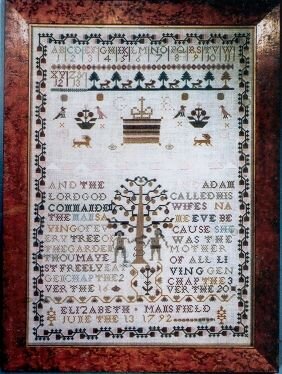
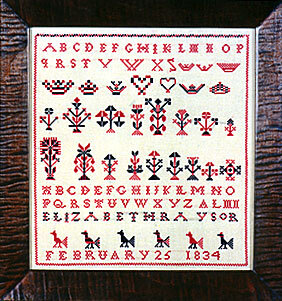
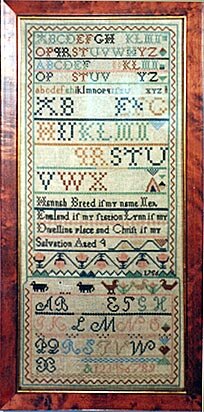
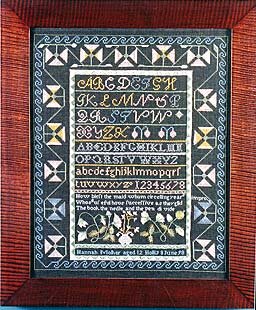
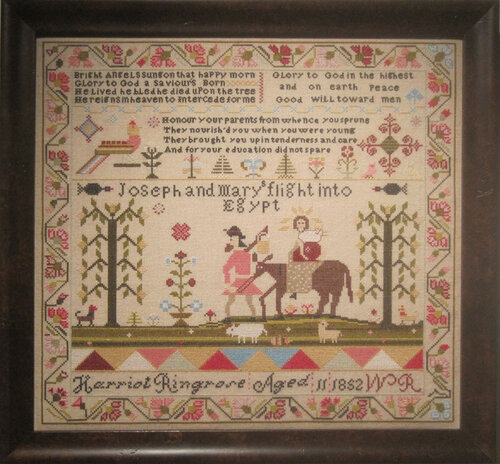
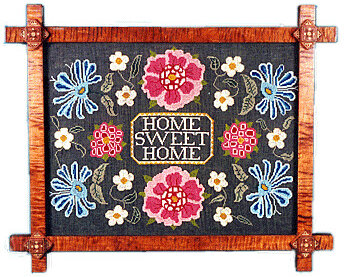
Praise the Lord enthron'd on high ... Read more about Ann Jones 1776 - Cross Stitch Pattern Note from the designer - "Several band samplers very similar to this one are in the collection of the Victoria & Albert Museum in London as well as in other important collections. This particular sampler came from the collection of The Scarlet Letter, and is now in a private collection. A... Read more about Ann Scutt circa 1675 - Cross Stitch Pattern There is so much going on in this fascinating English sampler that it's hard to know where to begin looking. Apart from the somewhat conventional Adam and Eve at the top center, adorable flying cherubs flank them and the apple tree, bearing gold rings and sprays of flowers. The verse is as... Read more about Catharine Metcalf 1836 English Pictorial This English sampler was made in Sheffield, South Yorkshire, featuring the Sheffield General Infirmary, a verse, a fashionably dressed man and woman, and a collection of animals in the lawn in front (sheep, fox, squirrels, rabbit, dog), all surrounded by a four sided berry border. The... Read more about Elizabeth Gray 1832 - Cross Stitch Pattern Note from the designer - "Elizabeth Eaton finished her sampler on the 21st of July in 1712. She used bold, primary colors suggestive of Scottish influence. The original sampler was stitched with both silk and fine wool threads on linen using cross, eyelet, rice, queen, herringbone, double... Read more about Elizabeth Eaton 1712 - Cross Stitch Pattern This letterndoek (lettering) form of Dutch sampler appears from the late 17th through the early 19th century. It is easy to recognize by its horizontal shape, and beautifully illuminated lettering, interspersed with various symbolic shapes and Biblical motifs. The color scheme used on so many of... Read more about Dutch Sampler of 1773 - Cross Stitch Pattern Note from the designer - "Elizabeth Mansfield finished her sampler in England on 13th June 1792, during the reign of King George III (1760-1820: note the cushioned crown in the upper third, marked on either side by the initials G R for George Rex). The original sampler was stitched on a very... Read more about Elizabeth Mansfield 1792 - Cross Stitch Pattern According to a note attached to the back of the original sampler, it was probably made near Newtown, Pennsylvania. The attribution at the center is surrounded by a typical Quaker leafy cartouche with opposing flowers and facing birds above. Other characteristic Quaker motifs include eight point... Read more about Elizabeth Mitchell 1828 - Cross Stitch Pattern Note from the designer: "This band sampler was designed after a piece in the collection of the Fitzwilliam Museum, most remarkable for the colorful, solidly filled geometric and floral sections. It also features double running stitch sections found on Italian embroideries of the sixteenth and... Read more about Elizabeth Pain 1667 - Cross Stitch Pattern Note from the designer: "A Pennsylvania German sampler that may not be, strictly speaking, a miniature, but is nonetheless small for its type. Typical Pennsylvania German folk culture motifs - birds, trees, hearts, flowers, crowns and stars - adorn it."
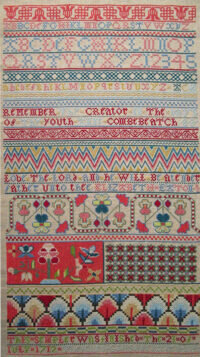
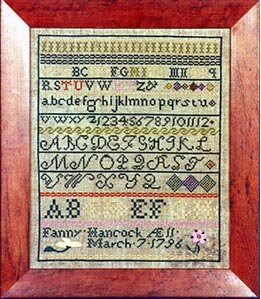
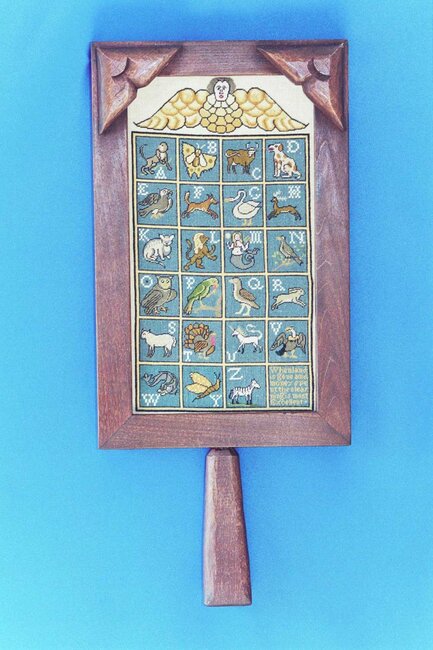
Origin and date:... Read more about Elizabeth Raysor 1834 - Cross Stitch Pattern This English sampler combines embroidered pictorial, alphabetic, and upholstery techniques, becoming in every sense a sampler of Ms. Topham's best work. Bargello work (also known as canvaswork, Irish stitch, flamestitch, or Florentine stitch) appeared on the earliest seventeenth century samplers,... Read more about Elizabeth Topham 1727 - Cross Stitch Pattern Note from the designer: "This sampler is a fine example of work done by Pennsylvania German girls in the early-to-mid nineteenth century. Similar motifs appear on the show towels that decorated kitchen and bedroom doors in these immigrant German households. It is thought that while the show... Read more about Elizabeth Wisler 1845 - Cross Stitch Pattern Note from the designer: "Adapted from a mid eighteenth century English sampler. The combination of several unusual stitch techniques with bold primary colors, makes this sampler outstandingly beautiful and a rewarding project to stitch. While the majority is done in cross stitch, large... Read more about Emily Lucille - Cross Stitch Pattern The Temperance Movement of the early nineteenth century began in the United States prior to 1808. Preachers, most notably John Bartholomew Gough, promulgated a pledge of abstinence from members of his congregation. While temperance efforts have existed as long as spirits have, the movement was not... Read more about Drunkenness by Emma George 1842 - Cross Stitch Pattern Band samplers of the 17th century exhibit the widest range of stitches and techniques. Counted thread stitches on linen were artfully combined with panels of floral, geometric, or figural cut and drawn work- a technique where the background threads of linen are carefully bound, then cut and pulled... Read more about EN 1657 A 17th Century Band Sampler - Cross Stitch Pattern This sweet little American sampler features two little houses above alphabets and a short verse: Would you be wise Each moment prize It is surrounded on four sides by a double sided satin stitched sawtooth border. Stitches used include cross, outline, stem filling, counted... Read more about Fanny M Forister 1828 - Cross Stitch Pattern Fanny Hancock's father, Ebenezer Hancock, was cousin to the famous John Hancock. Born in 1785, Fanny sewed her sampler at age 11. She married Nathaniel Parker of Boston in 1803, and died in 1834. The colors on the back side of her sampler retained much of their original brilliance, and are... Read more about Fanny Hancock 1796 - Cross Stitch Pattern What makes this early Victorian English sampler so intriguing are the wonderfully naive figures of Adam, Eve and St. Michael flanking the Tree of Life. St. Michael's sword is drawn to slay the serpent, but he hardly looks formidable with his large feet and doughy body. Playskool-like Adam and Eve... Read more about Frances Marshall 1838 - Cross Stitch Pattern Note from the designer: "This sampler was probably made in Rhode Island, a poor sister, perhaps, to the magnificent creations coming out of the girls' schools in Newport, Providence and Bristol at this same period, but bearing some similar "signatures". The squat, long-tailed bird at the... Read more about Freelove Hazard 1792 - Cross Stitch Pattern "Jesus permit thy Gracious name to stand as the first effort of an infant hand. And while her fingers on the canvas move, engage her tender thoughts to seek thy love. With thy dear children, let her have a part and write thy name thyself upon her heart." Note from the designer: "This American band sampler was originally worked in Lynn, Massachusetts. Hannah Breed is mentioned in Bolton and Coe's authoritative book American Samplers. Rows of lettering are intermixed with a row of sheep and cows, a verse, and floral bands. The verse says: ... Read more about Hannah Breed 1756 - Cross Stitch Pattern Note from the designer: "Hannah Mosher was born March 12th, 1786, in Hollis, New Hampshire, the fourth and last child of Abijah and Hannah Mosher. On March 7, 1813, she married the Rev. Walter Chapin of Woodstock, Vermont. Apart from this sketchy biographical information, found in the History of... Read more about Hannah Mosher 1798 - Cross Stitch Pattern Note from the designer: "From Dover, Massachusetts, comes Harriot Boardman's sampler, originally worked on a distinctive green linsey-woolsey found only on some North Shore samplers. A three-sided sawtooth border surrounds alphabet and numeral tests with geometric cross bands, two deer with... Read more about Harriet Boardman 1804 - Cross Stitch Pattern Note from the designer: "The flight into Egypt is a biblical event described in the Gospel of Matthew. Soon after Mary and Jesus were visited by the Magi, who had learned that King Herod intended to kill the male infants in that region, an angel appeared to Joseph in a dream telling him to flee... Read more about Harriot Ringrose 1852 - Christian Cross Stitch Pattern Note from the designer: "This original design blends a mid-18th century floral sampler border with a late 18th century lettering and cartouche style, and a mid-19th century sentiment. Instructions are provided for working the sampler in a different color scheme (red, blues, greens) on a neutral... Read more about Home Sweet Home Sampler - Cross Stitch Pattern Note from the designer: "The figures depicted on this original design were derived from wood block engravings of the 17th, 18th and 19th centuries. The format of the hornbook follows actual examples from the late 18th century. Hornbooks functioned as primers, used to teach young children their... Read more about Hornbook Bestiary - Cross Stitch Pattern Note from the designer: "This Scottish sampler features many distinguishing characteristics of samplers made in that country, most notably the arcaded pansy band across the top third, the four-sided floral border with double running stitch flourishes, and the famous mansion house. Of this large... Read more about Isabella Robeson circa 1809 - Cross Stitch Pattern Displaying the traditional color scheme of Scottish samplers, this beautiful and delicately stitched piece also employs a variety of interesting counted thread stitches including queen, doublerunning, four-sided, back, counted satin filling, cross, Algerian eyelet, and cross over one (petit... Read more about Janet Burnet 1830 - Cross Stitch Pattern This sampler was made in Scotland and includes many of the traditional motifs associated with samplermaking in this region. Firstly, Janet has included many initials of family members. However the initials at the center- G R 3 -refer to the then-reigning monarch, King George III. The flowering... Read more about Janet Carsels 1787 - Cross Stitch Pattern Go to page 47 Go to page 48 Go to page 49 Go to page 50 Go to page 51 Go to page 52 Currently on page 53 Go to page 54 Go to page 55 Go to page 56 |