Note from the designer: "This Scottish sampler features many distinguishing characteristics of samplers made in that country, most notably the arcaded pansy band across the top third, the four-sided floral border with double running stitch flourishes, and the famous mansion house. Of this large... Read more about Isabella Robeson circa 1809 - Cross Stitch Pattern
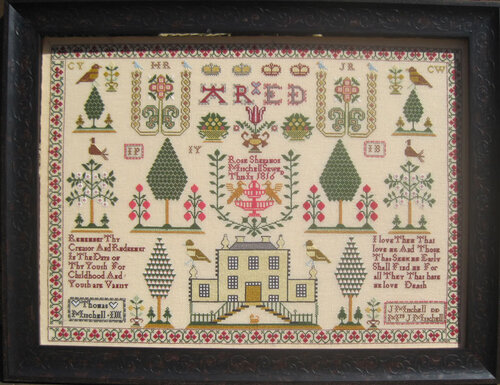
Rose's unusual middle name should have provided some clues about where she was born, and where she lived, but the name "Shenamon" is elusive despite my efforts to discover its origins as well as hers. It is spelled many different ways when researched (including Shinimon and Schinnamon which... Read more about Rose Shenamon Mitchell 1816 - Cross Stitch Pattern
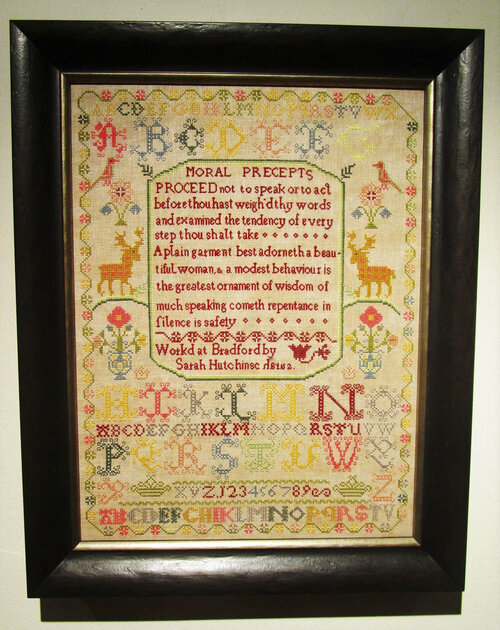
This is a reproduction of an English sampler made in Bradford, Yorkshire, that shows distinct influences of Scottish needlework traditions, particularly in the illuminated alphabets. The bold primary colors were reproduced from the front of the original sampler, which retains its amazing... Read more about Sarah Hutchinson 1762 - Cross Stitch Pattern
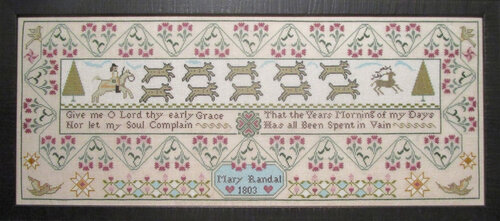
This design was excerpted from the top of an early nineteenth-century English sampler. It features an unusual and amusing hunting scene with a solo hunter on horseback pursuing a single hapless stag with a pack of ten spotted hounds on its trail.
This English sampler comes from the collection of the late Mr. and Mrs. Stephen Jarrett, who established Witney Antiques. It was featured in one of their exhibition catalogs in December 1996 titled "All Creatures Great and Small."
Note from the designer: This primitive marking sampler just captured my heart. The colors, the tone on tone, the rich patina and the whimsicalness of it. How can a marking sampler be whimsical you ask? Well, just look at the script K, L & M. They seem to be kicking up their heels and skipping along.... Read more about Susan Weeks Marking Sampler - Cross Stitch Pattern
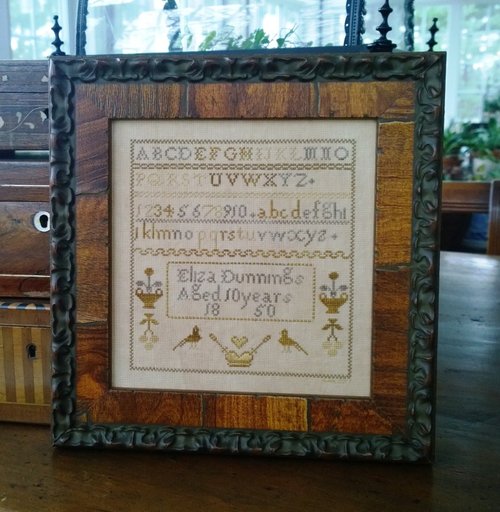
I love the simplicity of this little sampler. Eliza was 10 years old when she completed her sampler and beautifully hem stitched the edges.
Pattern is stitched on 40 ct Vintage Buttercream from Lakeside Linens using Gentle Arts threads with DMC conversion. Stitch count is 127 x 120. Finished size is 6" x 5.75".
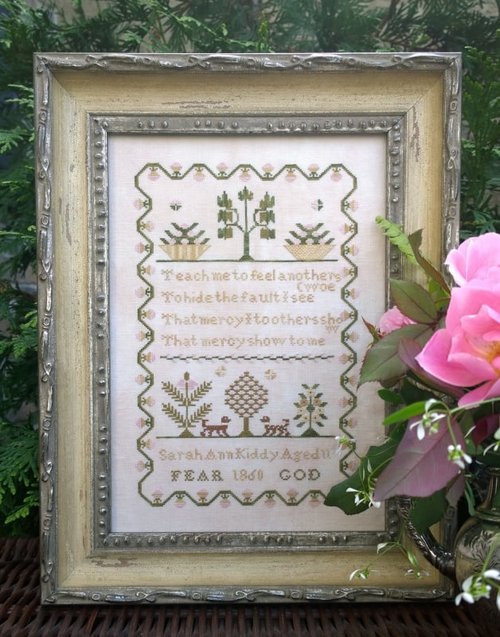
"Teach me to feel another's woe To hide the fault I see That mercy I to others show That mercy show to me." The saying on this sampler was written by Alexander Pope (1688-1744) who is considered to be one of the greatest English poets of the 18th century. Sarah stitched this sampler on... Read more about Sarah Ann Kiddy 1860 - Cross Stitch Pattern
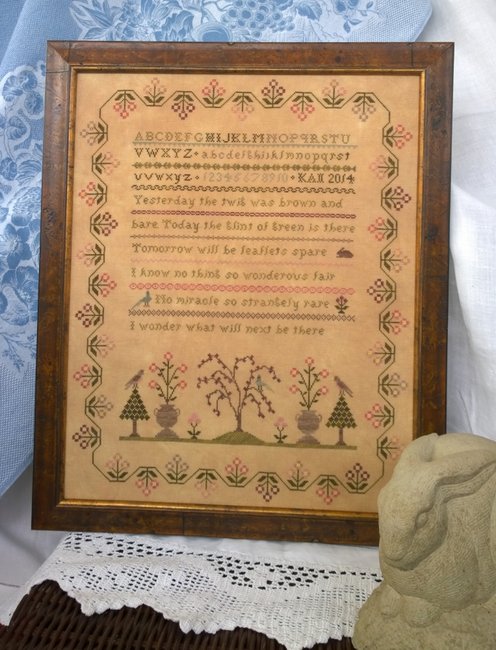
"The Miracle" by L.H. Bailey, "Yesterday the twig was brown and bare
Today the glint of green is there, Tomorrow will be leaflets spare, I know no thing so wondrous fair, No miracle so strangely rare, I wonder what will next be there".
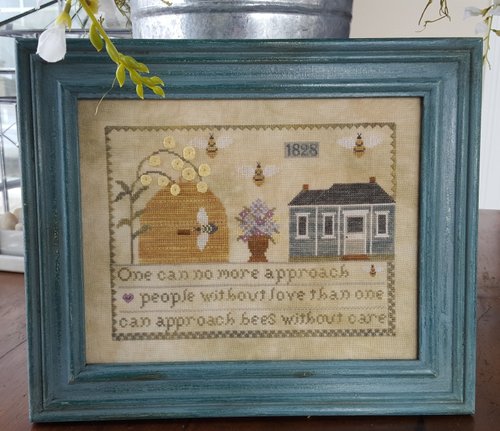
"One can no more approach people without love than one can approach bees without care" Leo Tolstoy 1828-1910. This piece is charted for cross stitch but instructions for a variety of stitches are included to stitch the bee skep and flowers.
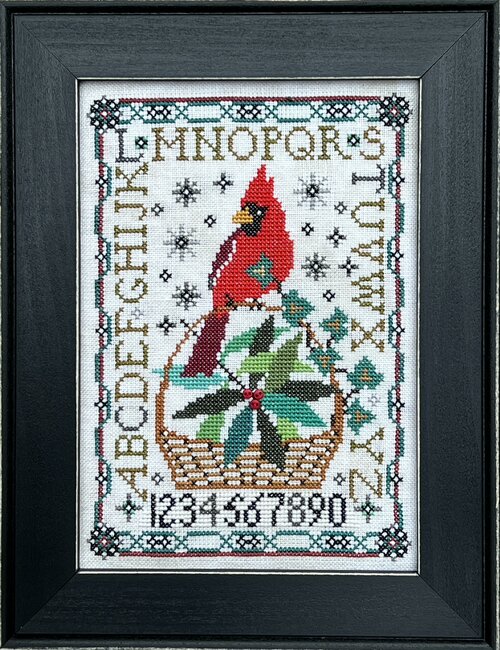
This is a revised version of an old design (#113). The original 2015 design has been out of print and I decided to rework it. JABC buttons are included. A cardinal is perched atop a basket of winterberry leaves berries.
Pattern is stitched on Fog Cashel using DMC threads. Stitch count is 80 x 112.
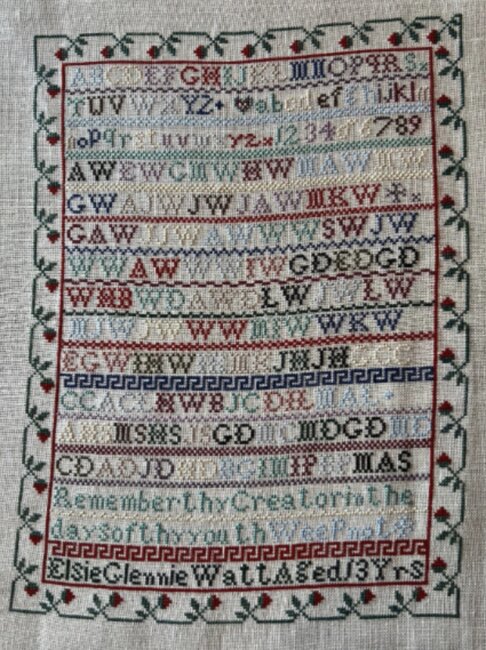
Elsie Glennie Watt is a reproduction of a colorful late 19th century genealogy sampler stitched on Zweigart 40 ct Mushroom/Light Mocha. I love the rainbow of colors that Elsie used in stitching her sampler that is perfect for a springtime stitch! And the border - whether roses or strawberries, what... Read more about Elsie Glennie Watt - Cross Stitch Pattern
Hannah Cummins stitched her sampler in Stockton, England in 1828 when she was 9 years old. A photo of the antique sampler is included in the package. "My thoughts before they are my own are to my God distinctly known. He knows the words I mean to speak ere from opning lips they break.
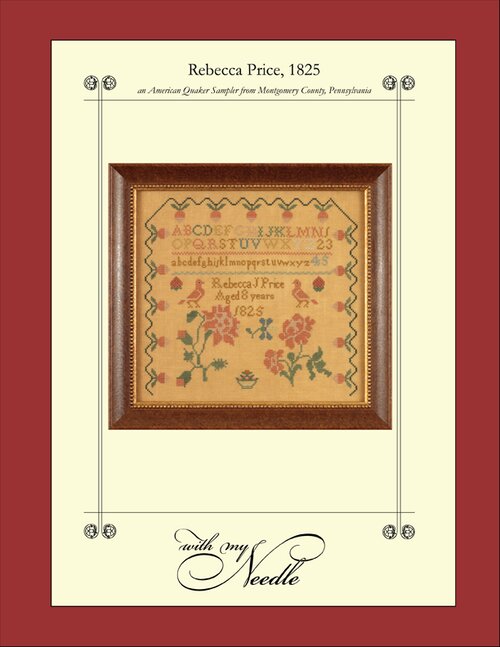
This sampler is an accurate reproduction of an American Quaker sampler from Montgomery County, Pennsylvania. A small image of the antique and a brief family genealogy are included in the package of this sweet sampler.
Model stitched on 36 ct. Straw by Weeks Dye Works using Needlepoint Inc. thread with DMC substitutions listed. Stitch count is 143 x 132.
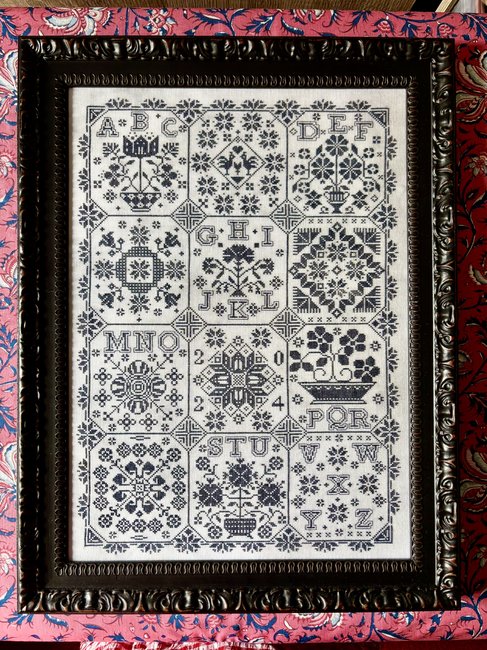
Alphabet Medley is stitched as one grand piece with 12 blocks, each featuring alphabet letters surrounded by intricate motifs and symbols.
However, that's not all. As a special bonus, you will also receive a 12-page booklet, with each block charted separately and given its own unique border.... Read more about Alphabet Medley - Cross Stitch Pattern


 801-495-0908
 ⇅
⇅

 Cart
Cart Wishlist
 Large Spool - #2600 Dove Grey
 Large Spool - #2692 Black
 Large Spool - #2021 Natural White
 Large Spool - #2024 Bright White
 Small Spool - #2600 Dove Grey
 Small Spool - #2692 Black
 Small Spool - #2021 Natural White
 Small Spool - #2024 Bright White
 Large Spool - #2600 Dove Grey
 Large Spool - #2692 Black
 Large Spool - #2021 Natural White
 Large Spool - #2024 Bright White
 Small Spool - #2600 Dove Grey
 Small Spool - #2692 Black
 Small Spool - #2021 Natural White
 Small Spool - #2024 Bright White
 Large Spool - #2600 Dove Grey
 Large Spool - #2692 Black
 Large Spool - #2021 Natural White
 Large Spool - #2024 Bright White
 Small Spool - #2600 Dove Grey
 Small Spool - #2692 Black
 Small Spool - #2021 Natural White
 Small Spool - #2024 Bright White