801-495-0908
 ⇅
⇅

 Cart
Cart Wishlist
 Large Spool - #2600 Dove Grey
 Large Spool - #2692 Black
 Large Spool - #2021 Natural White
 Large Spool - #2024 Bright White
 Small Spool - #2600 Dove Grey
 Small Spool - #2692 Black
 Small Spool - #2021 Natural White
 Small Spool - #2024 Bright White
 Large Spool - #2600 Dove Grey
 Large Spool - #2692 Black
 Large Spool - #2021 Natural White
 Large Spool - #2024 Bright White
 Small Spool - #2600 Dove Grey
 Small Spool - #2692 Black
 Small Spool - #2021 Natural White
 Small Spool - #2024 Bright White
 Large Spool - #2600 Dove Grey
 Large Spool - #2692 Black
 Large Spool - #2021 Natural White
 Large Spool - #2024 Bright White
 Small Spool - #2600 Dove Grey
 Small Spool - #2692 Black
 Small Spool - #2021 Natural White
 Small Spool - #2024 Bright White
Samplers Page 60
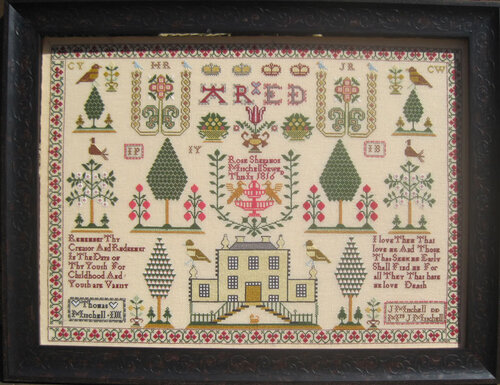
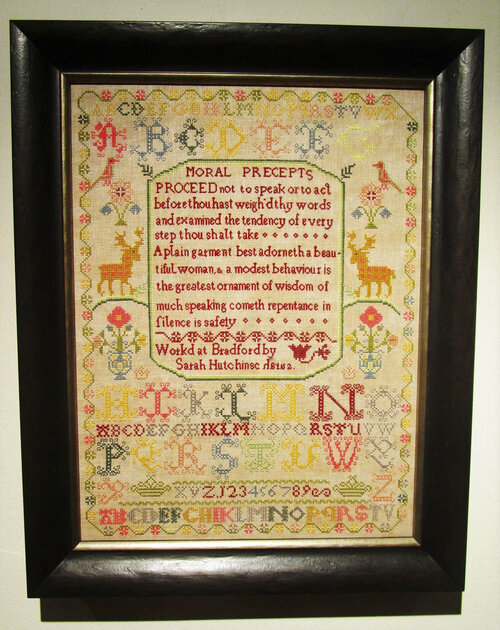
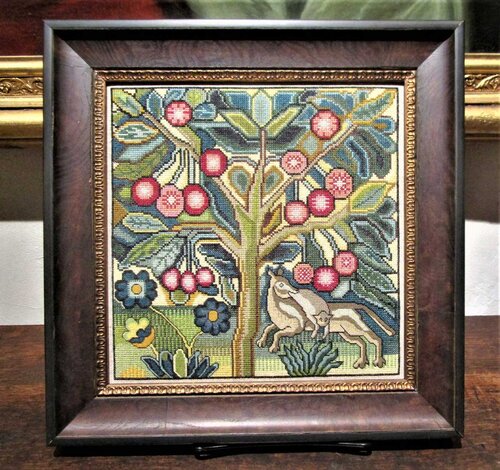
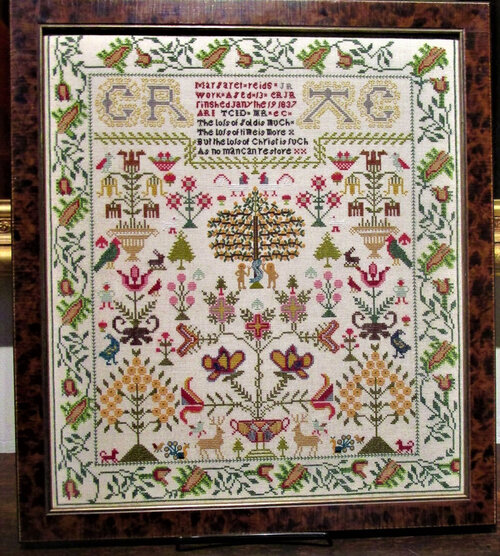
Note from the designer: "This Scottish sampler features many distinguishing characteristics of samplers made in that country, most notably the arcaded pansy band across the top third, the four-sided floral border with double running stitch flourishes, and the famous mansion house. Of this large... Read more about Isabella Robeson circa 1809 - Cross Stitch Pattern Displaying the traditional color scheme of Scottish samplers, this beautiful and delicately stitched piece also employs a variety of interesting counted thread stitches including queen, doublerunning, four-sided, back, counted satin filling, cross, Algerian eyelet, and cross over one (petit... Read more about Janet Burnet 1830 - Cross Stitch Pattern This sampler was made in Scotland and includes many of the traditional motifs associated with samplermaking in this region. Firstly, Janet has included many initials of family members. However the initials at the center- G R 3 -refer to the then-reigning monarch, King George III. The flowering... Read more about Janet Carsels 1787 - Cross Stitch Pattern This is a very finely stitched classic Scottish sampler featuring three complete rows of beautifully illuminated letters, an arcaded floral band as well as other traditional motifs including peacocks, birds drinking at the fountain of life, feather trees and family initials. A four sided berry... Read more about Katie Sym 1769 - Cross Stitch Pattern Note from the designer: "This Scottish sampler is a riot of brilliant color and intricate motifs, from the Scotsman in his kilt playing a traditional dulcimer (which looks like a butter churn) in the upper left, to an elaborate mansion house fronted by a three dimensional turkeywork lawn in the... Read more about Katharine Mitchel circa 1785 - Cross Stitch Pattern Rose's unusual middle name should have provided some clues about where she was born, and where she lived, but the name "Shenamon" is elusive despite my efforts to discover its origins as well as hers. It is spelled many different ways when researched (including Shinimon and Schinnamon which... Read more about Rose Shenamon Mitchell 1816 - Cross Stitch Pattern This is a reproduction of an English sampler made in Bradford, Yorkshire, that shows distinct influences of Scottish needlework traditions, particularly in the illuminated alphabets. The bold primary colors were reproduced from the front of the original sampler, which retains its amazing... Read more about Sarah Hutchinson 1762 - Cross Stitch Pattern This colorful William III English needlework vignette is executed entirely in gros and petit point stitches (cross stitch over one and two threads of linen). It depicts a large gros point fruiting tree above a scene with very finely stitched petit point leaves, flowers, and two animals, the larger... Read more about Needlework Panel of a Fruit Tree With Two Animals- Pattern The original Scottish antique sampler had never been framed and so it was in excellent condition with the same vibrant, unfaded colors on the front as well as on the back. An unusual, elaborate four-sided undulating floral and leaf border surrounds a central reserve with a brief moral verse. Adam... Read more about Margaret Reid 1837- Cross Stitch Pattern The original sampler, made in England in 1848, was stitched with cross, counted satin, petit point, and eyelet stitches on an extremely fine glazed linen of approximately fifty threads per inch.
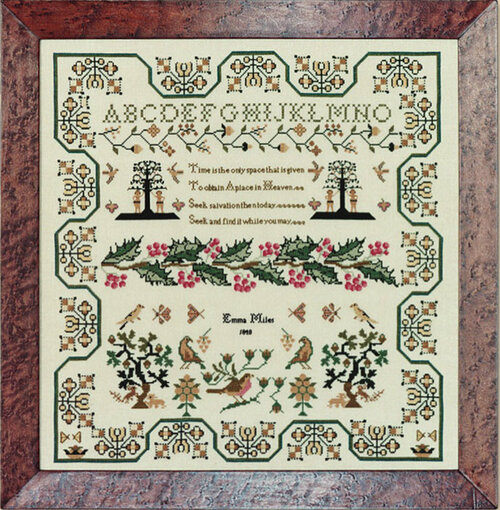
It is unusual to find such a meticulously and finely stitched sampler at this late date, when... Read more about Emma Miles 1848 - Cross Stitch Pattern This design was excerpted from the top of an early nineteenth-century English sampler. It features an unusual and amusing hunting scene with a solo hunter on horseback pursuing a single hapless stag with a pack of ten spotted hounds on its trail.
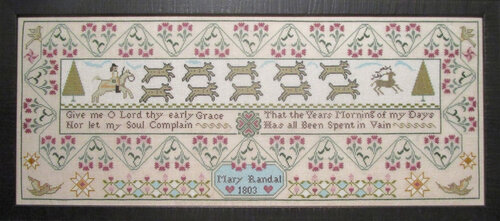
The verse reads: Give me O Lord thy early... Read more about Mary Randal 1803 - Cross Stitch Pattern This English sampler comes from the collection of the late Mr. and Mrs. Stephen Jarrett, who established Witney Antiques. It was featured in one of their exhibition catalogs in December 1996 titled "All Creatures Great and Small."
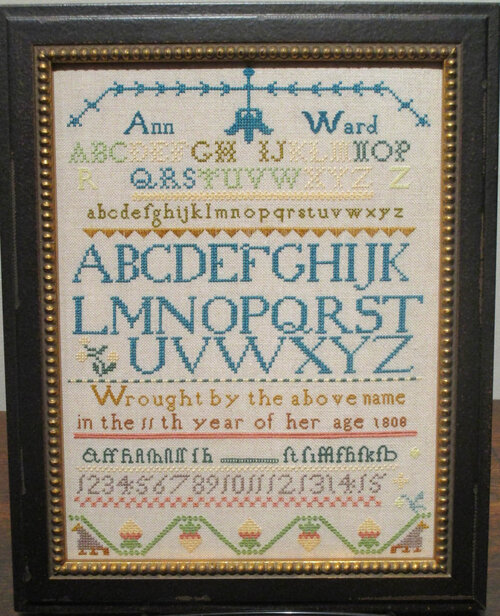
The work is extremely fine and accomplished,... Read more about Elizabeth Ginger 1735 - Cross Stitch Pattern This is a reproduction of a Quaker sampler made in Chester County, Pennsylvania consisting of alphabets, numerals, ligatures* and lineal patterns executed in a variety of stitches. The uppermost border with the dangling central flower is often seen on American Quaker samplers of this period (see... Read more about Ann Ward 1808 - Cross Stitch Pattern This English sampler features a three-sided floral border surrounding thirteen lines of alphabets, neatly cross-stitched in several different lettering styles. Mary Wagstaff was likely born in Huyton, Lancashire in 1809, completing this sampler when she was ten years old. She passed away in... Read more about Mary Wagstaff 1819 - Cross Stitch Pattern A sampler from the collection of the Fitzwilliam Museum in Cambridge, England.
Skill and expertise in sampler-making did not necessarily peak in the mid-to-late seventeenth century and then wane during what is often called the "golden age" of English sampler-making. These skills... Read more about Rachel Jarratt circa 1760 - Cross Stitch Pattern This amazing, unprecedented English sampler illustrates so many unique and bold elements of design, stitched in a balanced way inside a four-sided strawberry border. In all my decades of study I've never seen an antique sampler with quite this much bizarre personality.
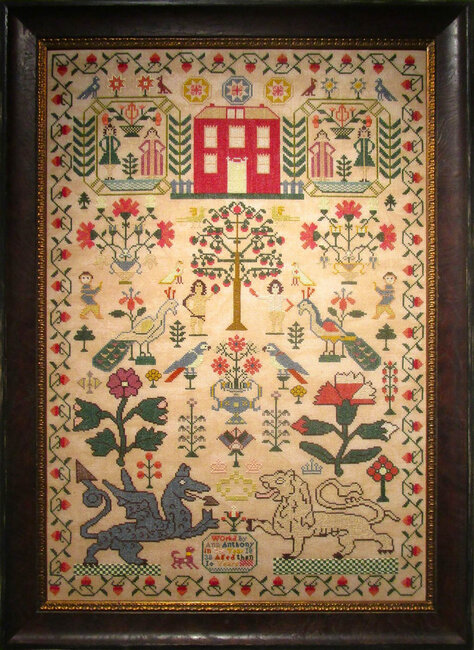
At the top is a... Read more about Ann Anthony 1838 - Cross Stitch Pattern Here is a dainty and colorful mid-eighteenth-century English sampler executed entirely in cross and petit point stitches making it a suitable project for any skill level.
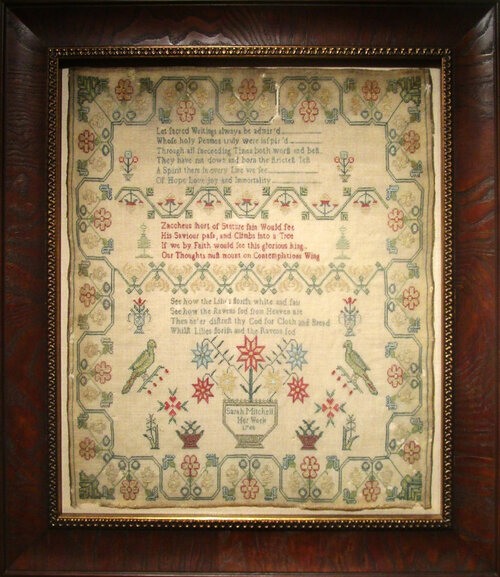
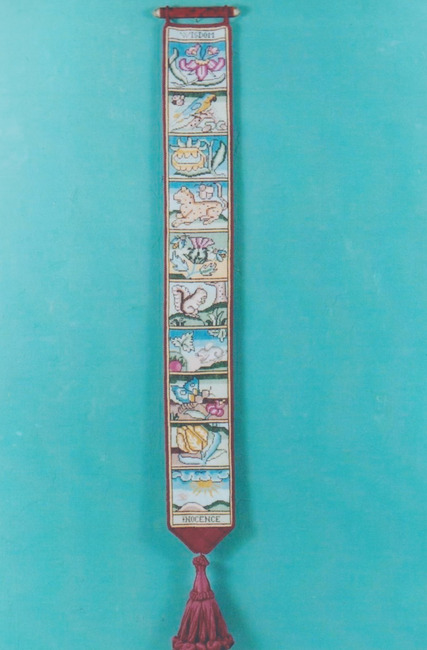
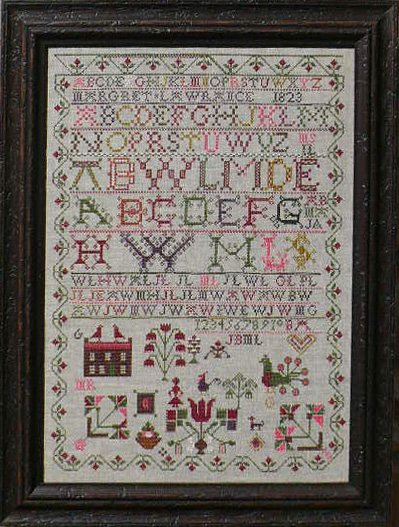
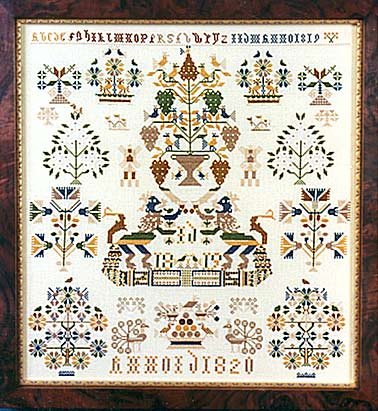
A four-sided arcaded border of daisies and dianthus surrounds three pious verses with delicate horizontal floral bands... Read more about Sarah Mitchell 1758 - Cross Stitch Pattern The canvaswork piece from which this bell pull was derived is a book cover, and dates to the first quarter of the 17th century. square tent stitched vignettes, reproduced here in the panels of the bell pull covered the book's spine vertically. It seems appropriate that the allegorical figures of... Read more about Wisdom and Innocence Bell Pull - Cross Stitch Pattern Characteristically ornate illuminated alphabets are featured on this classic Scottish sampler. Other stylistic elements indicating its origin include the peacock with seven tail feathers and three rows of initials of the maker's family. The illuminated alphabets on this particular sampler are... Read more about Margret Lawrance 1823 Scottish Sampler - Cross Stitch Cross stitch pattern by Scarlet Letter that is a reproduction of a Dutch sampler from the German Sampler Museum.
Pattern is stitched on 35 ct linen using Soie d'Alger silk threads with DMC conversion. Stitch count is 276 x 255. Finished size is 15.77" x 14.57". Cross stitch pattern from Sugar Stitches featuring a snowman in winter and the word "January"!
Model stitched on 28 ct. raw natural cashel linen using DMC floss. Stitch count is 117 x 111. Cross stitch pattern from Sugar Stitches featuring a valentines themed monthly sampler for February!
Model stitched on 28 count Raw Natural Cashel Linen using DMC floss. Stitch count is 117 x 111. Cross stitch pattern from Sugar Stitches featuring a house, sheep and the words "Irish Blessings" and "March"!
Model stitched on 28 count Raw Natural Cashel Linen using DMC floss. Stitch count is 117 x 111. Cross stitch pattern from Sugar Stitches featuring a chicks, Easter eggs and the words "Welcome Spring" and "April"!
Model stitched on 28 count Raw Natural Cashel Linen using DMC floss. Stitch count is 117 x 111. Cross stitch pattern from Sugar Stitches featuring bees, a beehive and the words "Welcome Summer" and "June"!
Model stitched on 28 count Raw Natural Cashel Linen using DMC floss. Stitch count is 117 x 111. Cross stitch pattern from Sugar Stitches featuring a lighthouse, ice cream cones and the words "Stars and Stripes" and "July"!
Model stitched on 28 count Raw Natural Cashel Linen using DMC floss. Stitch count is 117 x 111. Cross stitch pattern from Sugar Stitches featuring a carousal, beach toys and the words "Summer Fun" and "August"!
Model stitched on 28 count Raw Natural Cashel Linen using DMC floss. Stitch count is 117 x 111. Cross stitch pattern from Sugar Stitches featuring a schoolhouse, crayons and the words "Back to School" and "September"!
Model stitched on 28 count Raw Natural Cashel Linen using DMC floss. Stitch count is 117 x 111. Cross stitch pattern from Sugar Stitches featuring a Holiday celebration with a snowman and the words "Happy Holidays" and "December"!
Model stitched on 28 count Raw Natural Cashel Linen using DMC floss. Stitch count is 117 x 111. Cross stitch pattern from Sugar Stitches featuring cherry cake, cherry pie, cherry cupcakes, and more!!
Model stitched on 28 count Raw Natural Linen using DMC floss. Stitch count is 117 x 111. Cross stitch pattern from Sugar Stitches featuring jack-o-lantern pumpkins decorated with sunflowers for autumn!
Model stitched on 28 count Raw Natural Cashel Linen using DMC floss. Stitch count is 117 x 111. Cross stitch pattern from Sugar Stitches featuring a girl holding a strawberry!
Model stitched on 28 count Raw Natural Cashel Linen using DMC floss. Stitch count is 117 x 111. Cross stitch pattern from Sugar Stitches featuring a delightful Christmas sampler complete with the word Noel and a festively decorated home!
Model stitched on 28 count Raw Natural Cashel Linen or the fabric of your choice using DMC floss. Stitch count is 117 x 111. Cross stitch pattern from Sugar Stitches featuring many spring flowers and the word "May"!
Model stitched on 28 ct. raw natural cashel linen using DMC floss. Stitch count is 117 x 111 and the finished size is 8.36" x 7.93". Note from designer: The chart is in full color and features buttons by The Bee Company.
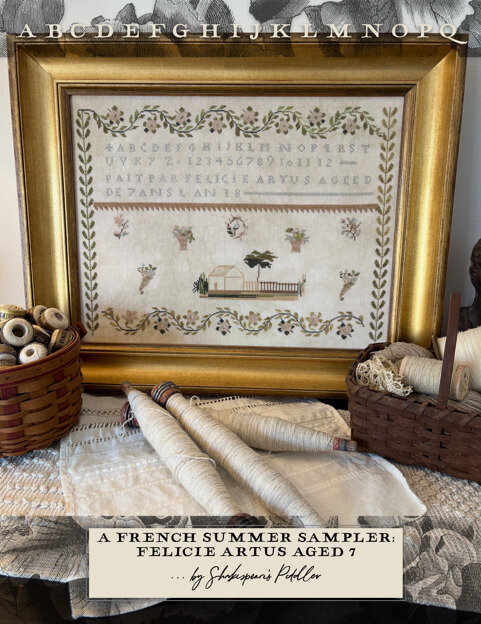
Pattern is stitched on 40 count Graham Cracker Linen or 40 count Mushroom/Light Mocha Newcastle with Gentle Arts and DMC threads. Full DMC conversion provided (3888 discontinued). The Bee Company button not listed. Stitch count is 120 by 120. Fabric is 40 count Flax by Zweigart using Classic Colorworks. Stitch count: 90 x 127. This piece will fit in a 5 by 7 frame, if the rabbet is shallow enough. The original sampler is a charmer, and can you believe Felicie was only 7? As always, my charts come with a little essay about the antique, and my thoughts about what make the sampler special, in this case, those beautiful, organic borders, the color palette, the airy space contained within, and the... Read more about A French Summer Sampler - Cross Stitch Pattern Cross stitch pattern from Shakespeare's Peddler featuring a lovely basket of flowers!
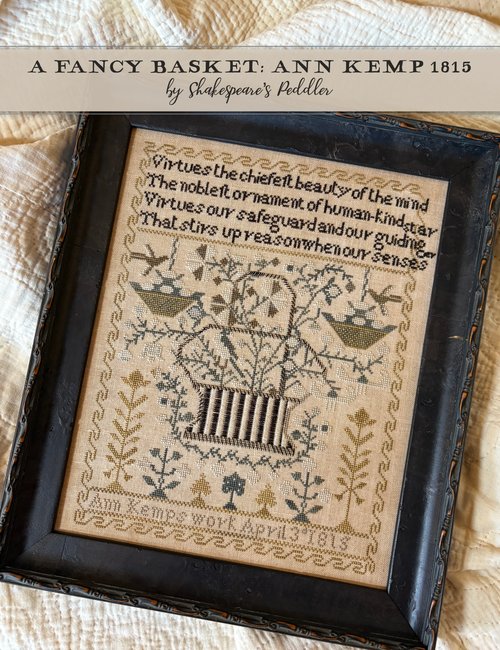
Pattern is stitched on 40 count Country Mocha Newcastle by Zweigart using the Gentle Arts threads. Stitch count is 79 by 58. Finished size is 4" x 3". Pattern by Shakespeare's Peddler featuring an antique sampler design with the words "Virtues the chiefelt beauty of the mind. The Noblest ornament of human kind. Virtues our safeguard and our guiding star. That stirs up reason when our senses".
Pattern is stitched on 40 ct. linen... Read more about A Fancy Basket: Ann Kemp 1815 - Cross Stitch Pattern
$16.00 Sale $12.79
|